In this episode, Peter welcomes back Nav Chandel, a distinguished professor and world-renowned expert in mitochondrial biology, for a conversation that challenges many conventional assumptions about mitochondria and their role in health and aging. Nav begins by explaining what mitochondria do beyond ATP production, emphasizing their critical role in cellular communication and signaling. He explores how mitochondria communicate through hydrogen peroxide, metabolites, and mitochondrial DNA and RNA, and how these signals influence inflammation, immune function, and epigenetic regulation. The conversation then turns to the relationship between mitochondrial dysfunction and aging, including what the term “mitochondrial dysfunction” actually means and why it is often misused. Drawing on his own research, Nav takes a deep dive into metformin, explaining its effects on mitochondrial function, metabolism, and inflammation. He examines the evidence for its potential benefits in preventing age-related diseases and why findings from cancer trials have been disappointing. Finally, Nav offers an evidence-based assessment of popular mitochondrial supplements and interventions, including urolithin A, alpha-ketoglutarate, methylene blue, and hyperbaric oxygen. Throughout the discussion, Peter and Nav separate established science from speculation, providing a clearer understanding of mitochondrial biology and its implications for health and longevity.
Subscribe on: APPLE PODCASTS | SPOTIFY | RSS | OVERCAST

“My mission for The Peter Attia Drive has always been to provide you with the most rigorous, evidence-informed insights on longevity. To do that without cluttering your experience with ads, we rely entirely on our premium members. If you’d like to support the work that makes this mission possible, consider becoming a premium member.”
– Peter
We discuss:
Timestamps: There are two sets of timestamps associated with the topic list below. The first is audio (A), and the second is video (V). If you are listening to this podcast with the audio player on this page or in your favorite podcast player, please refer to the audio timestamps. If you are watching the video version on this page or YouTube, please refer to the video timestamps.
- Mitochondrial function: energy production, cellular building blocks, and signaling beyond the powerhouse model [A: 3:30, V: 0:11];
- Electron transport and reactive oxygen species: how mitochondrial energy production creates cellular signaling byproducts [A: 9:45, V: 7:09];
- Oxidative stress and aging: defining antioxidants and antioxidant systems, and the limits of supplementation [A: 12:30, V: 10:43];
- Mitochondrial signaling: metabolites, epigenetic regulation, and immune activation beyond ATP [A: 20:15, V: 18:42];
- How mitochondrial DNA and RNA can activate immune pathways and whether chronic low-level leakage contributes to long-term inflammation and aging [A: 24:30, V: 23:48];
- How mitochondrial release of cytochrome c can trigger cell death or stress signaling [A: 28:30, V: 28:18];
- Mitochondrial dysfunction: survival without mitochondrial ATP production, glycolytic compensation, and the central role of cellular signaling [A: 29:45, V: 29:35];
- How to assess one’s mitochondrial function [A: 34:00, V: 34:10];
- The role of VO2 max and mitochondrial efficiency in maximizing your marginal decade [A: 41:00, V: 41:48];
- Mitochondrial dysfunction and aging [A: 46:30, V: 47:52];
- Metformin mechanisms: gut accumulation, complex I inhibition, and indirect effects on metabolism and exercise [A: 52:45, V: 54:57];
- Metformin and aging: does metformin provide true geroprotective benefits beyond glucose control? [A: 1:04:00, V: 1:07:50];
- Metformin and cancer: why most cancer trials have failed, and how its efficacy depends on tumor-specific uptake [A: 1:08:15, V: 1:12:48];
- How pollution and viral infections trigger inflammation, and the potential role of metformin as therapy [A: 1:19:15, V:1:25:25];
- Clonal hematopoiesis, inflammation, and mitochondrial metabolism: metformin’s role in limiting age-related immune dysregulation [A: 1:22:45, V: 1:29:34];
- Takeaways on the benefits and risks of using metformin as a geroprotective drug [A: 1:24:45, V: 1:31:51];
- Views on tests that claim to measure mitochondrial function [A: 1:30:15, V: 1:38:23];
- The Warburg effect and cancer metabolism: why Nav doesn’t think mitochondria in cancer cells are dysfunctional [A: 1:32:45, V: 1:41:01];
- Mitochondrial supplements: urolithin A and berberine [A: 1:35:00, V: 1:43:36];
- Mitochondrial supplements: α-ketoglutarate [A: 1:42:45, V: 1:52:28];
- Mitochondrial supplements: citrulline, carnitine, CoQ10, NR, and NMN [A: 1:45:00, V: 1:55:05];
- Interventions touted to boost mitochondrial health: SS-31 and methylene blue [A: 1:47:30, V: 1:58:10];
- Hyperbaric oxygen and low-oxygen therapy: any real benefits for health and longevity? [A: 1:51:15, V: 2:02:31];
- Red light therapy: exploring its effects on mitochondria via cytochrome c oxidase and whether purported benefits have a real basis [A: 1:55:30, V: 2:07:21];
- The case for funding basic research to understand metabolism [A: 1:59:45, V: 2:11:50]; and
- More.
Show Notes
Mitochondrial function: energy production, cellular building blocks, and signaling beyond the powerhouse model [A: 3:30, V: 0:11];
- Peter had Nav on the podcast 7 years ago [episode #31], and there’s so much new stuff to talk about
- He always likes to ground people in what the mitochondria are
- Unfortunately, mitochondria has become one of the top 10 buzzwords on social media, so there’s no chance that anybody listening or watching us hasn’t heard the term, but that second and third order understanding might be a little foggy
What do mitochondria functionally do?
- It’s not only mitochondria, but the other big buzzword is mitochondrial dysfunction
- So if you’re going to talk about mitochondrial dysfunction, why don’t we start with mitochondrial function?
- We are NOT going to discuss how mitochondria are made or degraded and how many different kinds of mitochondria there may be.
- We’re going to focus on one thing: mitochondrial function
- Most people know mitochondria as the powerhouse of the cell because it makes the ATP and that gives you the power for your muscles, your neurons to fire, and for a long time, most of us just thought about mitochondria as an ATP generator
“When mitochondrial dysfunction comes, does it happen in aging or in heart failure? It’s you don’t make enough ATP.”‒ Nav Chandel
- Now remember, glycolysis can also make ATP, but mitochondria is much more efficient and can give you a lot more
- It’s very simple, and all the great theories around mitochondrial dysfunction related to any particular disease (if it is causal) or the natural aging process is all about ATP
Nav is NOT going to talk about the ATP because there’s a lot more that mitochondria do
- To back up, the electron transport chain generates a protomotive force, basically a voltage which can be harnessed to make ATP
- That process is coupled to something called the Krebs cycle (or the TCA cycle), and it turns out that the TCA cycle is the anabolic engine also in your cells
1 – Mitochondria make 2 things: make ATP and make the building blocks (the metabolites) for new lipids, new nucleotides (like DNA, RNA), new amino acids (the building blocks of proteins) ‒ people forgot that mitochondria is an anabolic engine
- We’ll get into it with cancer in a second
- That’s what classically, the great biochemist of the 20th century taught us, and that’s what’s in your textbooks
What has changed in the last 30 years
- And Nav has been part of that revolution
2 – Mitochondria also communicate
- They’re just not an organelle sitting on the side, and things like mTOR, when they get activated or deactivated (mTOR is a big decision maker of metabolism)
- Your genes being turned on and off, they’re deciding cell fate, how a cell becomes what it does
The paradigm that mitochondria is just sitting there giving you ATP, giving you metabolites (it has no decision-making properties) ‒ that has changed
Let’s back up and give folks a sense of size and scale
Are there any cells in the body that don’t have mitochondria?
- Red blood cells
Absent red blood cells, when you consider all the other cells which have mitochondria, what is the approximate cellular density of mitochondria?
- It depends
- Nev doesn’t know these numbers
- Hepatocytes are full of them ‒ we’re talking thousands, maybe more
- Instead of worrying about are they dense or they’re not dense, if you look at them from what they’re doing:
- There’s the ATP
- There’s the metabolites
- But what Nav really wants to get into is the third aspect which a few mitochondria could probably fulfill
- And so that way, you don’t have to always think about mitochondrial biogenesis.
Peter is thinking more in terms of supply and demand mismatch
- For example, are they being paired to cells in density based on energy need or metabolite need?
- Because for example, a hepatocyte doesn’t actually need much ATP, but it needs a lot of anabolic precursor
- It makes glucose, for example
- Peter assumes that in the hepatocyte, the density is optimized more towards anabolism, whereas in a very energy dense cell like a muscle cell where ATP is probably more important than precursor to building blocks, you’re optimizing around this other function of ATP generation ‒ that’s what Peter was asking about
- On a first approximation, that’s true, although because there’s a third function, that simple theory, Nav doesn’t disagree with that
“I just don’t think about it anymore in those simple terms because there’s a third function that is becoming very dominant.”‒ Nav Chandel
- And Nav actually doesn’t know how this third function (that he’s going to talk about) fits into that paradigm that Peter just explained, and that’s why he’s stopped thinking about more or less mitochondria
Mitochondria are constantly generating signals to the rest of the cell
- These signals are optimized for cellular function
What are these signals?
- One of them is the electron transport chain is not a perfect system and it leaks electrons
- It can leak a little bit of electrons or a lot of electrons to make H2O2 (it makes superoxide first and then H2O2)
- People used to think H2O2 (hydrogen peroxide) in cells is damaging, damaging, damaging
- The oldest theory of aging says that as you get older, your mitochondria degenerate and they make copious amounts of H2O2 to cause degeneration of the muscle, of the neuron
{end of show notes preview}
Would you like access to extensive show notes and references for this podcast (and more)?
Check out this post to see an example of what the substantial show notes look like. Become a member today to get access.
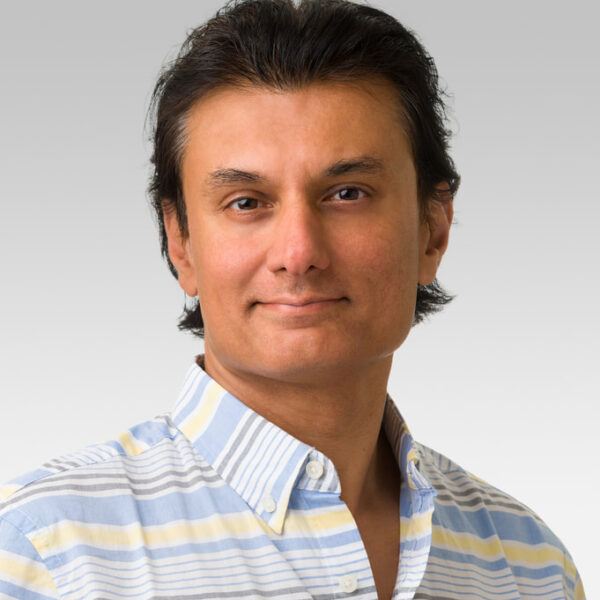
Navdeep Chandel, Ph.D.
Navdeep (Nav) Chandel earned a BA in Mathematics and Ph.D. in Cell Physiology from the University of Chicago. In 2000 he started his laboratory at Northwestern University on the concept of mitochondria as signaling organelles. Dr. Chandel is the David W. Cugell Professor of Medicine (Pulmonary and Critical Care), Biochemistry and Molecular genetics at the Feinberg School of Medicine at Northwestern University. His research focuses on understanding the function of mitochondria beyond the production of metabolites and ATP. He has characterized the role of mitochondria in cellular signaling through the release of reactive oxygen species (ROS) and other metabolites. In the field of cancer, his work established mitochondrial metabolism and ROS as necessary for tumorigenesis. Dr. Chandel is part of the Tumor Environment and Metastasis Team in the Robert H. Lurie Comprehensive Cancer Center of Northwestern University.
Dr. Chandel is a world renowned expert in mitochondria and metabolism. He authored a widely utilized introductory book, Navigating Metabolism. He has published over 300 peer reviewed papers. He received the Clarence Ver Steeg Faculty Mentor Award in 2013. In 2023, he was the co-recipient of the Lurie Prize in Biomedical Sciences given by the Foundation for the National Institutes of Health (FNIH). [Chandel Lab]
Website: Chandel Lab