Putting your carry-on into the overhead compartment of an airplane. Opening a jar of salsa. Getting yourself up off the toilet.
If you’re a typical person under the age of 60 or so, you do these things without giving them a moment’s thought. And worse: You don’t even contemplate that it could be otherwise in the future, even though you likely know older people who struggle with some or all of them. But the older you get, the more likely you are to find the activities of daily life to be a struggle.
Common commercial jars with diameters between 65 and 85 mm require 4.1 Nm and 6.6 Nm of torque to open, respectively;1 the average man aged 70-74 can only manage 5.4 Nm, and the average adult woman in her twenties can only exert 5.6 Nm, and declines from there 2 The fraction of people who either cannot lift or carry a ten-pound weight (think a full bag of groceries or a standard bag of dog food)—or who can only do so with difficulty—is 22% for people in their 60s, 28% for those in their 70s, and 46% for those 80 years and over.3 The corresponding fractions for standing up from an armless chair (or, by close analogy, getting up off the toilet) are 17%, 26%, and 45%; and for simply raising their unweighted arms above their heads, they are 16%, 15%, and 21%.3 Each of us can see the effects of aging on muscle and strength all around us, but somehow, we cannot imagine that it will happen to us.
And these are just the basic activities required to live independently: If you imagine yourself hiking in the Rockies, playing sports, skiing, or having sex in your seventies or beyond, the reserve of strength and fitness that you need to build now to enable those activities then is even greater.
And in addition to the direct need to build strength to carry out the business of life, observational studies consistently find that low muscular strength4,5,6 and power7,8,9 are associated with increased risk of death from all causes.
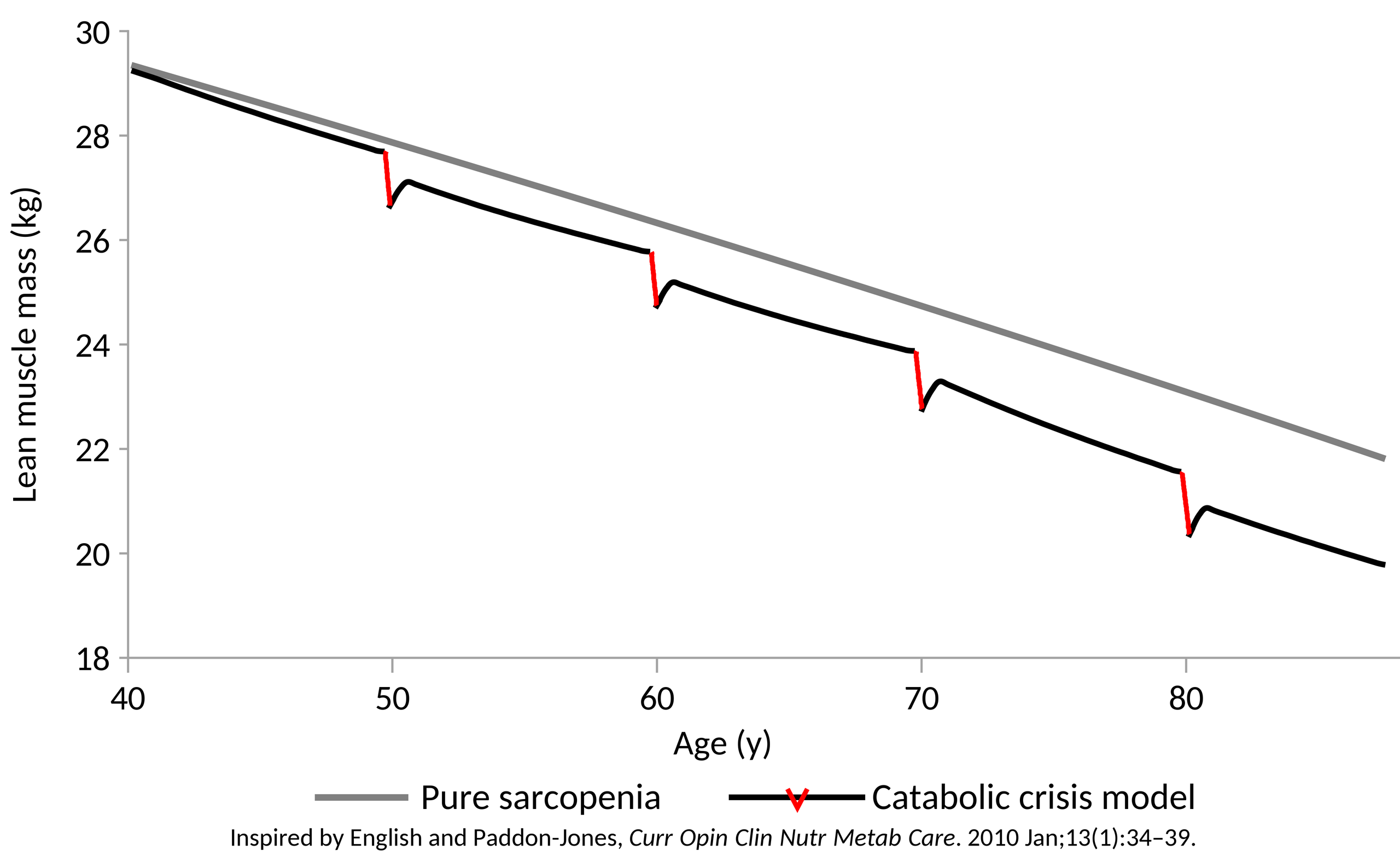
Muscle strength and mass typically peak in one’s 30s to early 40s, and power peaks even earlier. After that, strength is usually reported to decline roughly 1-2% per year, a decline that accelerates after age 70.10 And even this may be a misleadingly optimistic trajectory. Those figures usually come from cross-sectional comparisons of different people at different ages; when researchers instead follow the same people longitudinally, the rates of decline each decade are generally faster.11-16
Second, while population-level studies make it look as if people lose muscle mass, strength, and power in a smooth if foreboding downward path, many people’s trajectory is instead punctuated by occasional “catabolic crises”: sharp drops, most often triggered by injury or illness and tied to periods of inactivity, from which they never fully recover.17
Although pharma continues to work on drugs to increase muscle mass, the best tool to maintain or regain muscle mass, strength, and power with age is resistance training (RT), a mandatory component of the longevity toolkit. We have devoted an entire “Ask Me Anything” episode (AMA #71) to the topic, drawing on more than 30 hours of prior conversations with guests including Layne Norton, Andy Galpin, and Mike Israetel.
And resistance training’s benefits extend well beyond muscle mass and physical capacity. In randomized controlled trials, it also slows the loss of bone mass18 (or even builds it—see Belinda Beck’s appearance on The Drive); improves one’s glucose metabolism (for reasons that may be independent of gains in muscle mass19,20); ameliorates depression;21 and improves sleep quality.22 And RT is itself associated with reduced mortality and reduced risk of cardiovascular disease, cancer, and diabetes.23 This is consistent with the observational data on muscular strength4,5,6 and power7,8,9 being negatively associated with mortality from all causes combined.
This Premium Article is your guide to setting up and following through on a resistance training program designed to meet your long-term needs and goals for longevity: a longer life, and living the life you want when you get there. It puts the program first and the science second: what you are training for, the program itself, and only then the evidence behind it—including where that evidence is strong and where we are making judgment calls—followed by adjustments for pain and age, the Centenarian Decathlon, and the nutrition and recovery that make it all work.