
Strength and mobility are foundational for maintaining independence and the ability to navigate the world comfortably. And maintaining muscle mass as we age—combating age-related sarcopenia (muscle loss)—provides amino acid reserves and metabolic protection during inevitable periods of illness or stress. Despite this, uptake of resistance training—our best tool for building strength, mass, and mobility—remains low. A large percentage of our society remains in the “untrained” category, often for decades or even their entire lives.
Most popular training advice emphasizes optimization: how do you maximize muscle and strength? Programming for those kinds of goals entails lifting heavy loads, training near muscular failure, and doing so for long sessions, many times per week. While effective, these approaches impose meaningful costs in time, effort, and perceived risk, creating a barrier to entry for many people.
Here we encounter a mismatch: what is optimal isn’t necessarily what is sustainable for everyone, especially those new to weight training. For athletes and fitness enthusiasts with the right time, motivation, and interest, optimization is often the right goal. But for most people first starting a training program, the more relevant question is not how to maximize strength or hypertrophy—it’s how to obtain the majority of health benefits with the lowest possible cost in time and complexity.
A recent meta-analysis addresses that question directly.1 In untrained individuals, resistance training performed with only moderate loads, multiple sets, and just two sessions per week was shown to capture most of the strength benefit, produce near-maximal hypertrophy (muscle growth), and deliver the full improvement in mobility seen with more demanding protocols.
This study does not change what is optimal. But it does help define what is sufficient to obtain meaningful benefits when starting resistance training.
The study
This meta-analysis covers 192 studies examining resistance training in healthy adults, which excluded any studies enrolling well-trained athletes or military personnel. The analysis therefore combined participants at various levels, from participants with zero resistance training experience through people with established familiarity but no current dedicated training program. This is common within studies of this type: using untrained individuals tends to provide the maximum-possible signal of training benefit, while further allowing clean comparisons to a control group that simply continues to not perform structured resistance training.
This is worth noting because gaining additional strength and muscle mass becomes progressively more difficult and nuanced as training status increases: The type and amount of stimulus necessary to gain muscle in a bodybuilder is different than a person just starting out. That is an important caveat for interpreting these data if you already have an established routine and years of experience under your belt. Conversely, if you don’t already have that training experience or are looking to restart your resistance training practice, this is exactly the type of study that informs how an effective beginner-friendly training program could differ from advanced protocols.
To perform their analysis, the authors stratified interventions across three primary variables:
- Load: high (≥80% of one-repetition maximum (1RM)) vs. low (<80% 1RM)
- Volume: single vs. multiple sets per session
- Frequency: one, two, or three or more sessions per week
We’ll often focus on their group LM2, which stands for Low load (<80% of 1RM), Multiple sets, training 2 times per week. A standard optimum protocol would typically fall into the HM3 category: High load (≥80% of 1RM), Multiple sets, training in 3+ sessions weekly. Though less common, some athletic training protocols also follow an HM2 structure (≥80% 1RM, multiple sets, 2 times weekly). Resistance training interventions needed to be conducted for ≥6 weeks for inclusion in the meta-analysis.
Outcomes included changes in strength (measured by one-repetition maximum), hypertrophy (assessed via imaging-based measures of muscle size), and mobility (evaluated using functional tests such as Timed Up and Go and sit-to-stand performance). Outcomes were reported as standardized mean difference (SMD), roughly equivalent to how many standard deviations a training intervention improved an outcome relative to no training—permitting the authors to pool and compare effects between different studies.
One limitation worth noting is how “intensity” was defined. The analysis used load, as a percentage of the participant’s 1RM, as a proxy for intensity. They did not standardize variables such as proximity to failure or reps in reserve—key variables in peak resistance training paradigms. While this lack of standardization introduces variability, it also reflects real-world training conditions: individuals follow a wide range of prescriptions, which rarely begin training with strict control or attention to these levers.
It’s also worth noting up front that single-set protocols were nominally inferior to multiple sets for every weight or training frequency and showed no benefit over control for measures of mobility. Single sets are therefore insufficient to gain benefits in all three domains and are inferior in the two domains that show any benefit—if you’re in the gym, perform multiple sets per exercise.
Our research team spends hundreds of hours each month vetting studies and distilling dense literature to deliver evidence-informed insights on health and longevity. If you find value in our work, consider becoming a premium member and supporting our mission.














Strength
Maximal strength development is typically associated with heavier loads and training at a high frequency. It is well established that these variables produce superior strength outcomes, including in well-trained individuals.
The question here is how much of that benefit is lost early in training when these variables are reduced—how much strength can be gained while reducing the load or training frequency?
In this analysis, 77% of maximal standardized strength gains were obtained while using moderate loads performed twice per week. The LM2 group saw an SMD increase of 1.23 (95% CI: 1.01–1.46), compared to the maximal increase of 1.60 in the HM3 group (95% CI: 1.38–1.82) or 1.59 in the HM2 group (95% CI: 1.28–1.90). Comparisons between either of these high-load protocols and the LM2 condition were statistically significant in their network analysis.
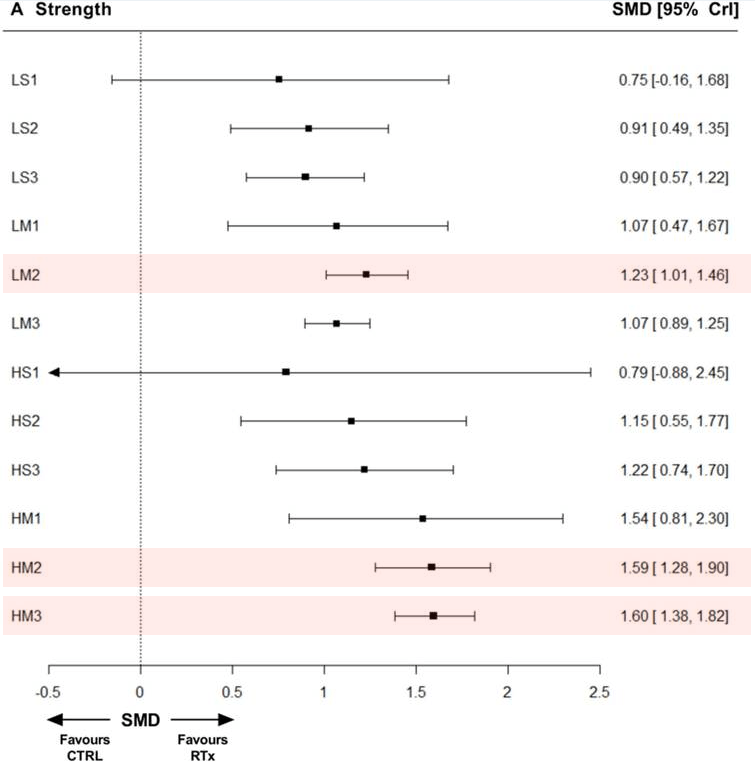
While this means that LM2 represents a meaningful reduction in strength gains compared to optimized protocols, these gains are still far from trivial. The majority of the strength adaptation is maintained despite a substantial reduction in training intensity and frequency.
In practical terms, this creates a favorable tradeoff for many people. Individuals can accept a modest reduction in peak strength gains in exchange for a significantly reduced time commitment and barrier to consistent participation.
Hypertrophy
The determinants of muscle hypertrophy become increasingly complex in trained individuals. Load, volume, and proximity to failure interact in nuanced ways, with emphasis placed on lifting near failure, heavy weights, and frequent training.
In untrained individuals, however, the signal is simpler.
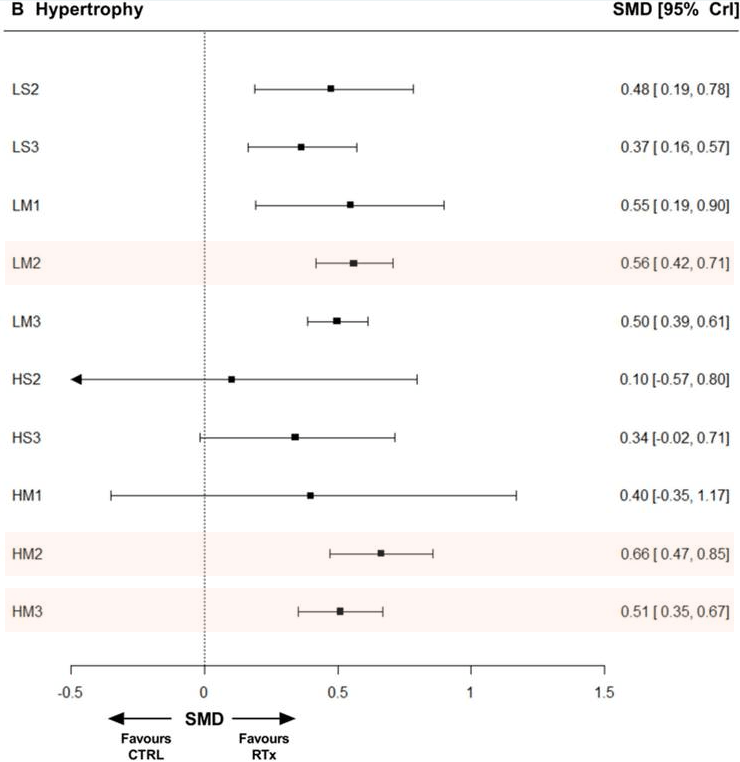
Across studies, differences in hypertrophy between lower-load and higher-load protocols were generally small and not statistically significant. It would be an overstatement to claim that this means the programs are strictly equivalent. But it does serve as evidence that muscle growth in untrained individuals is relatively insensitive to load, provided that sufficient volume is performed.
This aligns with observations that moderate loads, typically corresponding to approximately 8–12 repetitions per set, are sufficient to stimulate meaningful muscle growth.2
For individuals new to resistance training, this suggests that lifting lighter weights does not meaningfully compromise muscle growth—most if not all of the early hypertrophy can be captured with a moderate weight, lifted for multiple sets, just twice per week.
Mobility
Mobility outcomes showed the clearest and most consistent pattern.
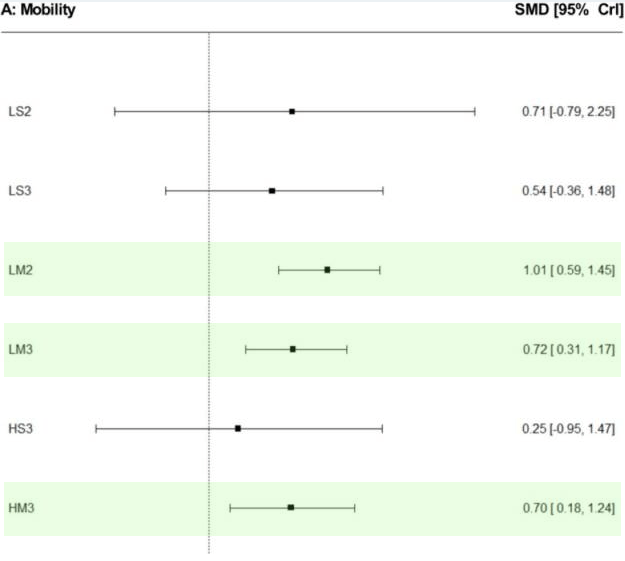
Any resistance training that included multiple sets resulted in significant improvements in functional mobility measures, regardless of load. No program that included only a single set per exercise showed a difference relative to control—the 95% confidence interval always crossed 0.
Of those that showed mobility benefits, there were no meaningful differences between groups.
In older individuals, these measures are directly tied to clinically relevant outcomes, including fall risk, independence, and overall functional capacity.3,4 And unlike strength, where we see a tradeoff between resistance training programs, mobility benefits appear to be fully captured regardless of the maximum weight being moved.
Minimum effective protocol
Taken together, this study gives us the ground to build something like a “minimum effective protocol”—we have an idea of where we get the most benefit per unit of effort or time commitment.
We’ve emphasized the LM2 group throughout for a reason—it shows maximal or near-maximal stimulation of muscle hypertrophy, full benefits towards mobility, and about three-quarters of strength gains relative to an optimal protocol in untrained individuals.
Translating these findings into practice, a minimum effective resistance training protocol for getting started with resistance training would include:
- Frequency: two sessions per week
- Load: moderate, roughly a weight that can be lifted for 8–12 repetitions
- Volume: multiple (3–4) sets per exercise
- Effort: moderate to hard, without requiring training to failure
- Exercise selection: emphasis on compound movements
This is not an optimized program for maximizing performance. It is a protocol designed to capture most of the physiological benefit while minimizing time, complexity, and physical strain. It is designed to get you in the gym, moving weight, reaping the health benefits of resistance training, stripped down to its essential parts.
Tying it together
The central takeaway from this analysis is not purely physiological. The motivation for us is behavioral.
For most individuals, the primary impediment to getting started with resistance training is not the absence of an optimal training program. It’s the inability to initiate and sustain training over time.
High-load, high-frequency protocols may produce greater peak adaptations, especially in experienced lifters, but they also impose higher costs in time, effort, and perceived risk. This results in fewer people even starting to train, as well as reduced adherence as people burn out or simply don’t want to commit the time to learning how to lift. There is a real tradeoff here: the benefits of resistance training are enormous, but optimized resistance training does take significant effort, dedication, and time committed to learning and working in the gym.
What this meta-analysis has provided is clear evidence that moderate-load, lower-frequency training still captures the majority of training’s benefit in inexperienced lifters. This type of training program has a significantly lower barrier to entry—you’re not being asked to lift as heavy as possible as often as possible. You’re being asked to lift a manageable amount of weight with intent and consistency, twice per week. With that, most of the benefits of an optimized protocol will still follow.
It is of course worth reemphasizing that these findings are specific to untrained individuals. As training status increases, factors such as proximity to failure, load, and training frequency become more important. Training plateaus are inevitable, and programs need to update and adapt accordingly.
But what this study provides is a straightforward entry point to resistance training: major strength gains, near-maximal muscle building, and complete mobility benefits of an “optimized” training protocol, all attainable with moderate weight lifted twice per week.
For a list of all previous weekly emails, click here.
References
1. Currier BS, Mcleod JC, Banfield L, et al. Resistance training prescription for muscle strength and hypertrophy in healthy adults: a systematic review and Bayesian network meta-analysis. Br J Sports Med. 2023;57(18):1211-1220. doi:10.1136/bjsports-2023-106807
2. Schoenfeld BJ, Grgic J, Van Every DW, Plotkin DL. Loading recommendations for muscle strength, hypertrophy, and local endurance: A re-examination of the repetition continuum. Sports (Basel). 2021;9(2):32. doi:10.3390/sports9020032
3. Barry E, Galvin R, Keogh C, Horgan F, Fahey T. Is the Timed Up and Go test a useful predictor of risk of falls in community dwelling older adults: a systematic review and meta-analysis. BMC Geriatr. 2014;14(1):14. doi:10.1186/1471-2318-14-14
4. Rikli RE, Jones CJ. Development and validation of criterion-referenced clinically relevant fitness standards for maintaining physical independence in later years. Gerontologist. 2013;53(2):255-267. doi:10.1093/geront/gns071