

Every few years, a new study reports finding chronic traumatic encephalopathy (CTE) in an alarming proportion of brains from former football players examined after death. The latest found its characteristic pathology in more than 90% of the brains donated from former NFL players.1 First described nearly a century ago in boxers as “punch-drunk syndrome,”2 CTE has since become most closely associated with professional football.
Most of us aren’t professional football players or boxers, though, so it is easy to file CTE away as just another occupational hazard of elite contact sports. But many of us played contact sports growing up, and some sustained a concussion or two along the way. So what exactly is CTE, and how relevant is it to the rest of us?
What is CTE?
CTE is a progressive neurodegenerative disease linked to repeated head impacts, making it one of the few neurodegenerative diseases with a known environmental trigger.
CTE is characterized by a distinct pattern of abnormal tau protein accumulation. Abnormal tau is also found in other diseases, including Alzheimer’s, but CTE has its own pathological signature: tau folds into a distinct structure and accumulates around small blood vessels at the depths of the cortical sulci—the deep grooves on the surface of the brain.3 The disease is classified into stages based on how widely the pathology has spread (see Figure). In later stages, tau pathology extends into additional brain regions, and the brain may show visible changes such as atrophy and enlarged ventricles.
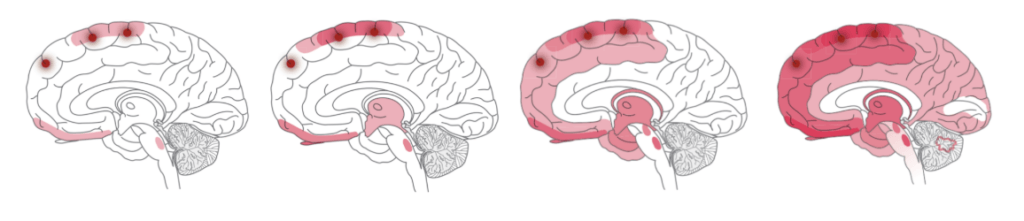
While CTE’s pathology is distinctive among neurodegenerative diseases, its symptoms are not. Reported features include memory loss and impaired executive function, as well as changes in mood and behavior. Dementia, gait instability, and other motor problems have also been described, particularly in people with more advanced disease.5 Because symptoms can arise years or decades after exposure, and because many affected individuals can also have other aging-related neurodegenerative diseases, it can be extremely difficult to determine which pathology is responsible for which symptoms.
This mismatch creates a fundamental diagnostic problem: CTE can only be confirmed by examining the brain after death. While work is underway to identify imaging or fluid biomarkers, there is no validated way to diagnose CTE in a living individual. Researchers have proposed criteria for a clinical syndrome associated with repetitive head impacts, but these do not reliably predict who will have CTE pathology at autopsy, underscoring the gap between clinical symptoms and the underlying disease.6
Our research team spends hundreds of hours each month vetting studies and distilling dense literature to deliver evidence-informed insights on health and longevity. If you find value in our work, consider becoming a premium member and supporting our mission.












What causes CTE?
When people hear “head injury,” they tend to think of concussions. But the strongest evidence on CTE points more broadly to cumulative exposure to repetitive head impacts—many of which may never produce recognizable symptoms. This distinction matters because counting diagnosed concussions captures only a small and imperfect fraction of a person’s total exposure.
Concussions are mild traumatic brain injuries (TBIs) diagnosed from signs and symptoms; routine brain imaging is typically normal. But a lack of obvious symptoms—and therefore a diagnosable concussion—does not mean that the brain has experienced no mechanical strain during an impact. The effects of subconcussive impacts can still accumulate, even when no individual hit produces noticeable symptoms.
In several brain-bank studies of former football players, the reported number of concussions was not associated with either the presence or severity of CTE. Measures intended to capture cumulative exposure, however—including years of play and estimates of the total number and intensity of impacts based on helmet-sensor data—were associated with both.7–9
This does not mean that concussions are harmless or irrelevant. Rather, concussion is a clinical threshold—not a line separating impacts that affect the brain from those that do not. Each head impact contributes to total exposure, whether or not it produces symptoms, and greater cumulative exposure increases risk.
Exactly how repetitive head impacts produce CTE in humans remains unknown, but there are clues. The earliest CTE lesions occur at the depths of the cortical sulci. Computational models have shown that these regions experience especially high mechanical strain during head impacts, helping explain why they may be particularly vulnerable. Work in cultured neurons has also shown that repetitive mechanical stretching causes tau—normally found in the signal-transmitting part of the cell—to move to the signal-receiving end, where it impairs normal neuronal signaling.10,11 Together, these findings offer a plausible path from repeated head impacts to tau pathology.
Not just for football players
If cumulative exposure is what matters, the high rates reported in former NFL players are not surprising. Postmortem studies have found CTE pathology in more than 90% of donated brains from former NFL players.1,5 These numbers are alarming, but families may be more likely to donate when a player had neurological symptoms or extensive head-impact exposure, meaning the results cannot be generalized to all former players. The latest study did, however, establish a conservative floor: confirmed CTE cases among donors meant that at least one-quarter of all former NFL players who died from 2016 through 2021 had some degree of CTE pathology at death.1 Importantly, this estimate describes an older generation whose football exposure largely preceded modern changes in contact practices, rules, equipment, and concussion management, so it cannot be assumed to apply to players today. It also counts the presence of any CTE pathology as positive, including early-stage lesions that may not be clinically symptomatic.
CTE has also been identified in people exposed to repeated head impacts through boxing, rugby, ice hockey, soccer, and other sports, as well as through military service or domestic violence (see Table for most well-established sports). In one brain-bank study of former male hockey players, 54.5% had CTE, including 96.4% of the professional players. Number of years played was strongly associated with both the presence and severity of CTE.12 A similar relationship between career length and CTE has been reported in rugby players.13
Table: Portion of brain samples that were confirmed to have CTE. Note that unless specified, these come from selected autopsy cohorts, meaning players’ families chose to donate their brain which may enrich the population for symptomatic individuals—these should not be considered prevalence statistics, nor do they reflect any recent changes to game-play. Studies with fewer than 10 individuals are not included. #Despite boxing being the original sport of interest for CTE, there are surprisingly few modern studies on it. CTE received a formal set of diagnostic criteria in 2016, making earlier statistics difficult to compare.17
| Sport | Level | % CTE+ within cohort (n) |
| Football | Youth/high school (unselected cohort) | 6.5% (8/124)14 |
| Beyond high school (unselected cohort) | 20% (3/15)14 | |
| College | 91% (48/53)8 | |
| NFL/Canadian football league | 88–99% (n=100+ per study)1,5 | |
| Ice hockey | Youth/high school | 9.5% (2/21)12 |
| College/semi-professional | 46% (13/28)12 | |
| Professional | 96.4% (27/28)12 | |
| Rugby | Amateur | 56.5% (13/23)13 |
| Elite | 100% (8/8)13 | |
| Soccer | Amateur | 17.4% (4/23)15 |
| Boxing# | Professional | 50% (7/14)16 |
But these are still highly exposed athletes drawn from selected brain banks. Estimating the risk for people with less extensive exposure requires cohorts that were not assembled specifically to study CTE.
One particularly useful study started with 750 autopsy cases from the Mayo Clinic Tissue Registry. Researchers used yearbooks and obituaries to reconstruct each person’s athletic history, then examined brain tissue for CTE without knowing who had played sports. Among men, 6.5% of former athletes met the full pathological criteria for CTE, compared with 2.4% of nonathletes.14
Football exposure again stood out, and the results varied sharply by level of play. Among the 15 men who continued into college or professional football, 20% had definitive CTE. Among the 124 who stopped after youth or high school football, 6.5% had definitive CTE, while another 4.8% showed possible signs in the tissue examined. Put another way, nearly 89% showed neither definitive CTE nor suggestive features. This does not make high school football risk-free, but it shows that CTE was far from inevitable in this cohort.
At the other end of the spectrum, CTE appears to be uncommon in populations not selected for contact-sport exposure. A large population-based study from a more diverse autopsy cohort found CTE in only 0.6% of brains, while a separate study found CTE in 2.2%, all of whom had documented history of neurological injuries.18,19 Across community cohorts, prevalence is usually 0–2%.
Taken together, these studies suggest that CTE is not confined to football or professional athletes, but it does not appear to be a common consequence of everyday life or a handful of isolated concussions. Risk rises with the duration and intensity of repeated head-impact exposure, with the clearest signal among people who spent many years participating in collision sports.
What we still don’t know
Autopsy studies provide only a snapshot of the brain after death. Researchers must reconstruct how a person functioned during life and cannot observe when the pathology began or how it progressed. Until validated biomarkers allow CTE to be studied in living people, the clinical significance of early-stage pathology—and why some people develop severe symptoms while others do not—will remain uncertain.
Most autopsy cohorts also consist of people who played sports decades ago, well before today’s limits on contact practices, concussion protocols, rule changes, and newer equipment. These changes may reduce cumulative exposure or lessen the consequences of individual impacts, but whether they will ultimately reduce CTE remains unknown—and any effect may take decades to become apparent.
Women represent another major blind spot. Nearly all CTE research has focused on male athletes, who historically had far greater exposure to collision sports. Women remain dramatically underrepresented in brain banks, and only a handful of pathologically confirmed CTE cases have been reported. But the number of women whose brains have been carefully examined—particularly former contact-sport athletes—is also very small. We therefore do not know whether the low case count reflects lower cumulative exposure, limited study, biological differences, or some combination.20,21
The bottom line
There is still much to learn about CTE, but a few conclusions can be stated with reasonable confidence. CTE is not confined to professional football—or even to sports—but the people at greatest risk are those with the highest cumulative exposure to repeated head impacts. Contact sports at any level can contribute to that exposure, but risk scales with years of play, and CTE is uncommon in the general population. While concussions should always be taken seriously, simply having a few concussions across the lifetime does not appear to be sufficient for causing CTE.
For now, prevention means reducing avoidable impacts in sports and daily life, especially among children, and limiting unnecessary contact during practices. Anyone with a suspected concussion should be removed from play, evaluated, and given time to recover before gradually returning to activities that carry another risk of impact.22 We still cannot define a “safe” number of hits, but fewer impacts—and adequate recovery when injuries occur—remain the most sensible approach.
For a list of all previous weekly emails, click here.
References
1. Daneshvar DH, Nowinski CJ, Abdolmohammadi B, et al. Prevalence of chronic traumatic encephalopathy at death in National Football League players: retrospective population based cohort study, 2008-21. BMJ. 2026;394:e100418.
2. Changa AR, Vietrogoski RA, Carmel PW. Dr Harrison Martland and the history of punch drunk syndrome. Brain. 2018;141(1):318-321.
3. Falcon B, Zivanov J, Zhang W, et al. Novel tau filament fold in chronic traumatic encephalopathy encloses hydrophobic molecules. Nature. 2019;568(7752):420-423.
4. Montenigro PH, Corp DT, Stein TD, Cantu RC, Stern RA. Chronic traumatic encephalopathy: historical origins and current perspective. Annu Rev Clin Psychol. 2015;11(1):309-330.
5. Mez J, Daneshvar DH, Kiernan PT, et al. Clinicopathological evaluation of chronic traumatic encephalopathy in players of American football. JAMA. 2017;318(4):360-370.
6. Arena JD, Stewart W, Schneider ALC, et al. Performance of traumatic encephalopathy syndrome criteria in identifying individuals with chronic traumatic encephalopathy. Nat Med. 2026;32(6):2037-2046.
7. McKee AC, Stern RA, Nowinski CJ, et al. The spectrum of disease in chronic traumatic encephalopathy. Brain. 2013;136(Pt 1):43-64.
8. Mez J, Daneshvar DH, Abdolmohammadi B, et al. Duration of American football play and chronic traumatic encephalopathy. Ann Neurol. 2020;87(1):116-131.
9. Daneshvar DH, Nair ES, Baucom ZH, et al. Leveraging football accelerometer data to quantify associations between repetitive head impacts and chronic traumatic encephalopathy in males. Nat Commun. 2023;14(1):3470.
10. Ghajari M, Hellyer PJ, Sharp DJ. Computational modelling of traumatic brain injury predicts the location of chronic traumatic encephalopathy pathology. Brain. 2017;140(2):333-343.
11. Braun NJ, Yao KR, Alford PW, Liao D. Mechanical injuries of neurons induce tau mislocalization to dendritic spines and tau-dependent synaptic dysfunction. Proc Natl Acad Sci U S A. 2020;117(46):29069-29079.
12. Abdolmohammadi B, Tuz-Zahra F, Uretsky M, et al. Duration of ice hockey play and chronic Traumatic Encephalopathy. JAMA Netw Open. 2024;7(12):e2449106.
13. Stewart W, Buckland ME, Abdolmohammadi B, et al. Risk of chronic traumatic encephalopathy in rugby union is associated with length of playing career. Acta Neuropathol. 2023;146(6):829-832.
14. Bieniek KF, Blessing MM, Heckman MG, et al. Association between contact sports participation and chronic traumatic encephalopathy: a retrospective cohort study. Brain Pathol. 2020;30(1):63-74.
15. McKee AC, Mez J, Abdolmohammadi B, et al. Neuropathologic and clinical findings in young contact sport athletes exposed to repetitive head impacts. JAMA Neurol. 2023;80(10):1037-1050.
16. Goldfinger MH, Ling H, Tilley BS, et al. The aftermath of boxing revisited: identifying chronic traumatic encephalopathy pathology in the original Corsellis boxer series. Acta Neuropathol. 2018;136(6):973-974.
17. McKee AC, Cairns NJ, Dickson DW, et al. The first NINDS/NIBIB consensus meeting to define neuropathological criteria for the diagnosis of chronic traumatic encephalopathy. Acta Neuropathol. 2016;131(1):75-86.
18. Rodriguez RD, Nowinski C, Suemoto CK, et al. Clinicopathological study of chronic traumatic encephalopathy pathology in a population-based cohort. J Neuropathol Exp Neurol. 2026;85(5):425-432.
19. Suter CM, Affleck AJ, Lee M, et al. Chronic traumatic encephalopathy in a routine neuropathology service in Australia. J Neuropathol Exp Neurol. 2022;81(10):790-795.
20. Tiemensma M, Byard RW, Vink R, Affleck AJ, Blumbergs P, Buckland ME. Chronic traumatic encephalopathy (CTE) in the context of longstanding intimate partner violence. Acta Neuropathol. 2024;148(1):1.
21. Suter CM, Affleck AJ, Pearce AJ, Junckerstorff R, Lee M, Buckland ME. Chronic traumatic encephalopathy in a female ex-professional Australian rules footballer. Acta Neuropathol. 2023;146(3):547-549.
22. Patricios JS, Schneider KJ, Dvorak J, et al. Consensus statement on concussion in sport: the 6th International Conference on Concussion in Sport-Amsterdam, October 2022. Br J Sports Med. 2023;57(11):695-711.


