
Do you know what Zone 2 is? How do you know when you’re in it? By measuring heart rate? Lactate? How hard it feels? Do you know why you’re doing Zone 2 in the first place? How much should you do—and why?
In recent years, few topics have generated more confusion in the exercise world than Zone 2 training. Part of that confusion, I’ll admit, is something I’ve probably contributed to over the years.
I’ve been rather specific and prescriptive about Zone 2—I’ve intentionally defined the Zone 2 used by elite athletes and their coaches, to distinguish this from a generic “moderate-to-easy pace” or the “Zone 2” heart rate zone on a fitness tracker. But there is a downside to being very precise about a prescription: the prescription can start to sound more important than the objective it was designed to serve.
The reality is that Zone 2 training is a means to an end. It is not the end itself.
I’ve emphasized Zone 2 training as a centerpiece of cardiorespiratory fitness protocols. For the right person, it can be. But before you think about how much Zone 2 you personally should do, how precisely you need to define it, or how worried you should be about staying inside some narrow range, there is a more basic question we need to answer first:
What are you actually trying to accomplish?
The base and the peak
Zone 2 is one possible component of aerobic training, performed at an intensity that can be sustained for dozens (if not hundreds) of minutes. Just as resistance training develops muscle strength, power, and size, aerobic training develops the cardiorespiratory system.
I like to visualize cardiorespiratory fitness as a triangle, with a modifiable base and peak. In this framework, the base of the triangle is your capacity for sustained, submaximal work, built mainly through metabolic flexibility and efficiency—namely improved fat oxidation and lactate utilization, increased mitochondrial density, and better movement economy—essentially, the ability to do more work with less oxygen. The triangle’s peak is your maximum aerobic capacity—the maximum amount of oxygen you can deliver to your mitochondria and use, measured as VO2 max—driven largely by stroke volume (the amount of blood pumped by the heart with each beat).
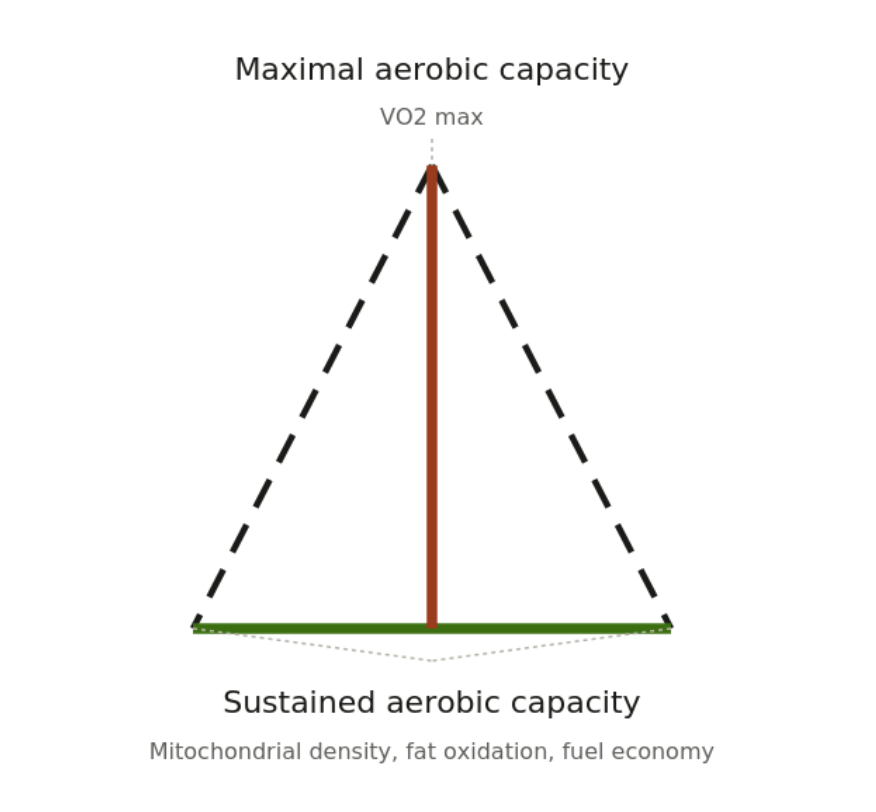
The goal is to maximize the total area of the triangle: building a wide base and high peak.
VO2 max, the peak of our triangle, is one of the strongest predictors of all cause mortality at any age, reliably predicts the physical activities we can take part in in our daily lives, and slowly decreases as we age. Building and maintaining a high VO2 max is a cornerstone of any healthy aging protocol.
Raising the peak of the triangle relies heavily on raising cardiac output, which responds best to work near max intensity—much like resistance training benefits from training near failure. This is where we need high intensity training, often referred to as VO2 max training, typically performed as a series of sustained intervals at a very high effort (see our conversation with Mike Joyner for a deep dive into VO2 max training and longevity).
And to support a higher peak, we need to lay down the structural foundation—a baseline aerobic capacity upon which the VO2 max can be built. Aerobic capacity is largely driven by training volume: the amount of time spent training multiplied by the intensity of that training (volume = time x intensity).
To maximize the area of our triangle, we therefore want to maximize along these two axes: work done near maximum intensity and total training volume.
Expanding the base with training volume
The most time-efficient way to improve VO2 max is through high-intensity work. Because heart rate can lag considerably during a three- to five-minute interval, I don’t use heart rate as the primary way to prescribe that intensity—instead, I prefer to use rate of perceived exertion (RPE), while keeping the external workload as consistent as possible. On a bike, that might mean holding a constant power for four minutes; while running, it might mean holding a constant speed and grade. If the workload is appropriate, the interval should feel very hard, particularly toward the end, while heart rate will naturally rise throughout the effort.
Our training protocol is going to include high intensity training to raise our cardiorespiratory peak. Building in training volume—time and intensity—is the path that can take many shapes.
Deciding how we go about adding volume depends on the constraints of our own lives and training opportunities—the real work of designing a cardio program is figuring out what’s capping your volume. Here, the question isn’t simply “Should I be doing Zone 2?” The question to ask is “What is actually limiting how much aerobic training I can do?”
If you have several hours to devote to cardiovascular training each week, the thing standing between you and more volume is fatigue: how much stress your body can absorb before recovery, consistency, and long-term progress start to suffer. But if you have only an hour or two available each week, you encounter a completely different constraint—the limiting factor for volume is no longer fatigue, it’s the time available.
This is what tells us how to train: as the practical constraint on volume changes, so too does the appropriate tool.
In terms of fatigue, Zone 2 grows the base cheaply—low intensity training is significantly less taxing on the body. Training near maximum intensity is physiologically expensive—you can only do so much of it before fatigue catches up with you. This is the primary utility of Zone 2: adding training volume when fatigue is the limiting resource.
But if training time is limited, you’re no longer trying to maximize the volume your body can tolerate throughout the week—you’re now trying to maximize intensity within an available hour or two. High fatigue is now an acceptable cost, and high intensity training becomes the better tool—providing as much volume as possible inside of a limited training window.
The goal of our training doesn’t change. The appropriate tool for the task does.
Putting it into practice
Individualized cardiorespiratory training programs generally follow this philosophy: use high-intensity training to increase the aerobic peak, while adjusting total training volume based on individual constraints.
If someone has near-unlimited training time, most of that volume will generally need to come at lower intensity simply because there is a limit to how much high-intensity work we can recover from. An 80:20 split of lower-intensity to high-intensity training is a useful heuristic and is broadly consistent with how many elite endurance athletes train, though the precise ratio varies considerably by athlete, sport, and phase of training. For someone doing seven or eight or more hours of aerobic training per week, I would generally expect the large majority of that time to be spent at lower intensity, with a smaller amount of dedicated high-intensity work to help raise the peak.
As we move down in available time, the ratio shifts. If someone told me they had six hours a week for cardiovascular training, I’d recommend roughly four of those hours in Zone 2 and two in higher intensity work. Closer to a 60:40 or 70:30 split between Zone 2 to high intensity. At 6 hours of available time, attempting all training at a high intensity would still be difficult to sustain and would raise the risk of excessive fatigue or injury—but at 6 hours, we are beginning to bias our time more towards higher intensity bouts.
When we get down to only two hours a week, we’re at the starkest shift in training focus. Here I might skip a dedicated Zone 2 training altogether, and put that time where the physiological return per minute is greatest—into two sessions with high intensity work. These sessions would include warming up with 10-15 minutes of Zone 2, then 10-15 minutes of Zone 3, followed by a 30 minute high intensity protocol: for example, one session of alternating 1 minute high intensity and 1 minute easy for half an hour, and the other session pushing pure VO2 max intervals with 4 minutes on and 4 minutes off. With a training budget that limited, getting the most out of each session becomes the priority—dedicated Zone 2 sessions may leave the protocol entirely.
Notice that the logic is the same throughout. The same goals are in place—dedicated high intensity training time and maximizing training volume throughout the week—even if the practice appears markedly different when our budget is limited by time rather than fatigue.
One caveat is worth noting here: this time-based framework assumes you already have some aerobic foundation to work from. For someone who is new to exercise, that assumption doesn’t hold—high intensity work is often prohibitively uncomfortable for a deconditioned person, and pushing into it too early raises the risk of injury or simply kills adherence before a habit forms. Tolerance is key when first building an aerobic base—and Zone 2 is often the right starting point.
Our research team spends hundreds of hours each month vetting studies and distilling dense literature to deliver evidence-informed insights on health and longevity. If you find value in our work, consider becoming a premium member and supporting our mission.














Finding Zone 2
Finding Zone 2 can be a source of confusion, but it doesn’t need to be—people generally fall into one of two buckets:
For people looking to truly optimize their training, the metabolic definition should be your guide: The upper bound of Zone 2 is the threshold at which local lactate production outpaces the muscle’s ability to clear it, causing excess lactate to spill over into circulation—typically around 2 mmol/L in metabolically fit people. This is typically measured in real time by blood testing during exercise at different measured power outputs—it’s tedious and technical, but worth it for those who want to train at an elite level, and I use these tools myself (for a deeper dive into Zone 2 training, check out AMA 79).
However, this level of precision isn’t necessary for the vast majority of people—if you’re training for recreation and longevity, we can rely on a proxy.
For most people, the “talk test” is our preferred metric: Zone 2 corresponds to an effort at which you can still speak in complete sentences, but you’d rather not carry on a conversation. You can answer a question, but doing so takes noticeable effort. If talking becomes genuinely uncomfortable, or you find yourself pausing to catch your breath, you’re above Zone 2. If you can chat easily without much effort, you’re below it.
This talk test is how we coach most of our patients because it’s simple, practical, and remarkably effective. We find that fitness trackers’ heart rate zones are too inconsistent between users and between exercise types. And while more sophisticated methods can define the zone more precisely, learning to recognize the right level of effort is easier and more than accurate enough to guide training for the majority of people who are training for recreation and longevity.
Then, once you’ve found this balance within a Zone 2 session—talking isn’t easy, but also isn’t overwhelming—the goal is to stay there. Sometimes I still find myself pushing too hard, or catch myself matching a training partner’s pace instead of my own prescribed intensity. But the entire value of a Zone 2 session comes from staying within the intensity that lets you recover quickly and show up for the next one. If your training program intentionally includes Zone 2 sessions, it’s worth remembering—upping the intensity without planned recovery days may hinder training progress more than it helps.
The bottom line — Zone 2 isn’t magic
Zone 2 isn’t a secret physiological lever, nor does it provide some sort of mitochondrial magic that only exists at this intensity. It’s a tool that lets you accumulate more aerobic training than you otherwise could, while minimizing cost in recovery. How much of it belongs in your program really depends on a simple question: Given how much time you actually have, what’s the best way to spend it?
You don’t need to memorize the “rules” about Zone 2. You need to ask what’s actually limiting your training—and let time tell you which zone to find.
And for a deeper discussion of aerobic training—whatever your fitness level may be—check out our recent AMA #79 on cardiorespiratory fitness.
For a list of all previous weekly emails, click here.