In this episode, Peter takes a deep dive into colorectal cancer (CRC) screening, explaining why it is one of the most preventable cancers and why getting screening right can have life-saving implications. He walks through how colorectal cancer develops and why it is uniquely well-suited to early detection and prevention, with a particular emphasis on the dual role of colonoscopy as both a diagnostic and therapeutic tool. Peter also examines the concerning rise in early-onset CRC among younger adults, highlighting why awareness and timely screening matter more than ever. The episode provides a practical guide to preparing for and evaluating the quality of a colonoscopy, including how to think about appropriate screening intervals and the real risks and tradeoffs involved. Finally, Peter explores the expanding landscape of non-invasive screening options, offering clear insight into what these alternatives can and cannot do so listeners can make informed decisions about their care at any age.
If you’re not a subscriber and listening on a podcast player, you’ll only be able to hear a preview of this episode. If you’re a subscriber, you can now listen to this full episode on your private RSS feed or on our website at the show notes page. If you are not a subscriber, you can learn more about the subscriber benefits here.
Would you like access to this entire podcast episode, its extensive show notes, and more premium content?
We discuss:
- CRC statistics and goals for this episode [1:00];
- Colorectal cancer development: polyp progression, risk types, and the window for prevention [4:00];
- Why colorectal cancer is uniquely screenable: direct visualization and the dual role of colonoscopy [6:30];
- Colonoscopy effectiveness: prevention through polyp removal and interpreting the NordICC trial data [8:15];
- Rising colorectal cancer in younger adults: trends, possible causes, and the case for earlier screening [12:15];
- Colonoscopy preparation: why bowel prep matters and how newer options improve the experience [16:45];
- Colonoscopy quality, polyp miss rates, and personalized screening intervals [20:00];
- Colonoscopy risks versus colorectal cancer risk: understanding the true risk-benefit tradeoff [29:30];
- Non-invasive screening options for CRC: benefits, limitations, and their role alongside colonoscopy [37:00];
- Colorectal cancer prevention principles: why screening matters and the role of colonoscopy [39:30]; and
- More.
Show Notes
CRC statistics and goals for this episode [1:00]
- Colorectal cancer (or CRC) is the 2nd leading cause of cancer death in the United States
- And it’s projected to be responsible for roughly 55,000 deaths this year, according to the American Cancer Society
⇒ That puts it behind only lung cancer as far as cancer mortality
“Unlike many other cancers, CRC is arguably the most preventable cancer we know of.”‒ Peter Attia
- The reason for this is that CRC follows a well-characterized slow progression from completely normal tissue to a benign polyp, to a precancerous polyp, to frank malignancy
- That progression almost always takes years, often a decade or more
- And because the colon is a hollow organ and sits outside the body (as crazy as that sounds), we can directly access and visualize it
We have the ability to not only detect those precancerous lesions, but also remove them before they ever become cancer
No other common cancer screening test can make that claim
- A mammogram can detect breast cancer
- A low-dose CT scan can detect lung cancer
- But neither of those are able to look directly at the cancer
- A colonoscopy can not only do that, but it can also remove the precancerous lesion in the first place
⇒ Yet a 2020 CDC estimate claims that 68% of colorectal cancer deaths may be prevented with screening, even at the traditional recommended intervals
Peter emphasizes, “That statistic should stop you cold.”
- We’re talking about a cancer that in most cases gives us a decades long window to intervene
- And we’re still losing nearly 70% of people out of that 55,000 deaths a year because they never walked through the front door to get a colonoscopy
Even more, Peter would argue that this number could be closer to 100% reduction in colorectal cancer death with more aggressive screening protocols—including starting earlier and screening more often
Goals for this episode
- Peter will cover the topic of CRC screening comprehensively
- He’ll start with the basic biology of colorectal cancer and why it’s uniquely suited to screening
- Then he’ll talk about the rise of early onset colorectal cancer in younger adults
- From there, he’ll go into the colonoscopy itself
- How to prepare for one
- How to ensure you’re getting a high quality exam
- How to think about screening intervals
- He’ll discuss real risks and trade-offs
- He’ll walk through the growing landscape of non-invasive screening alternatives: both stool-based tests and blood-based tests
- He’ll talk about what they can and can’t do
The goal here is to leave you with a very clear, practical picture of colorectal cancer screening, whether you’re 35 and wondering when to start or 55 and wondering when your Cologuard test is good enough
Colorectal cancer development: polyp progression, risk types, and the window for prevention [4:00]
- Colorectal cancer–as its name implies–develops in the colon and rectum [shown in the figure below], which is the final portion of the GI tract
The colon is roughly 5 feet long and consists of several segments
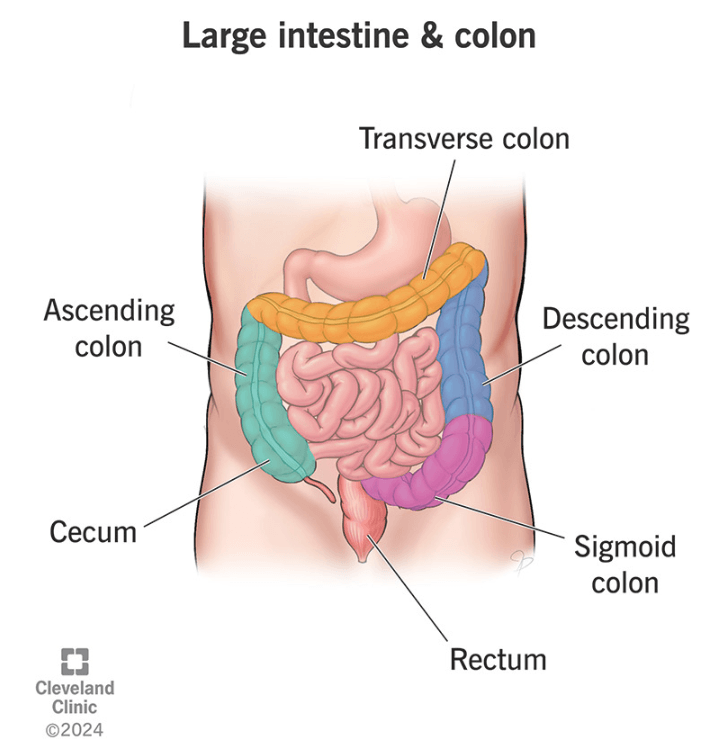
Figure 1. Anatomy of the colon. Image credit: Cleveland Clinic
- The cecum on the lower right part of your abdomen where the small intestine connects into it
- The ascending colon that rises up the right side of your abdomen
- The transverse colon crosses along the upper abdomen
- The descending colon down the left side
- The sigmoid colon as it transverses into the middle
- Then the rectum at the very bottom
Nearly all colorectal cancers begin as polyps
{end of show notes preview}