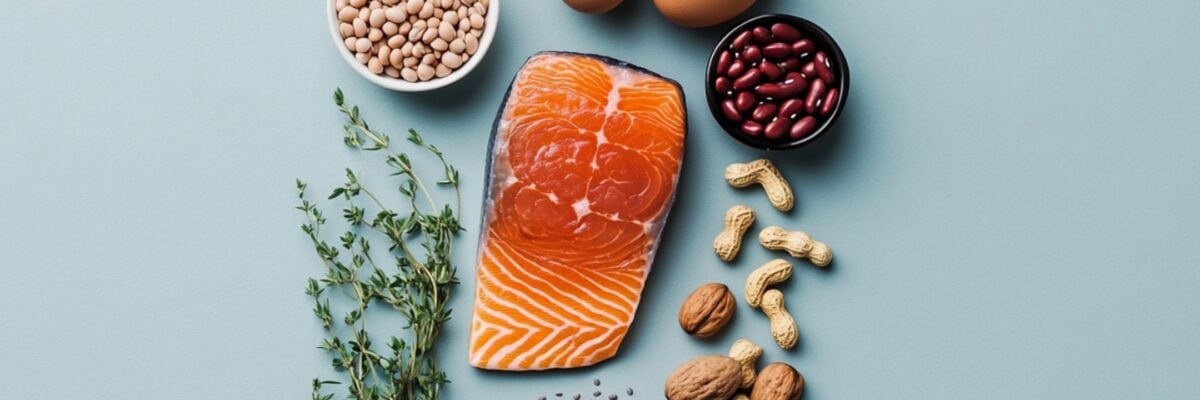
When it comes to fat loss, most of us need all the help we can get. With the modern American lifestyle being largely sedentary and characterized by easy access to highly palatable, energy-dense foods, it can be very difficult to maintain the calorie deficit necessary to lose fat and keep it off.
Whether or not a calorie deficit is achieved is determined by the difference between total energy in and total energy out. Assessing the “energy in” side of the equation is straightforward—add up the energy content of all food consumed. However, the “energy out” side is more complicated and much more difficult to accurately measure, as it varies by body composition, activity level, age, sex, and various other factors.
One component of total daily energy expenditure (TDEE) is the energy required to digest and metabolize food, termed the “thermic effect of food,” or “diet-induced thermogenesis” (DIT). DIT can account for ~10% of total energy expenditure, but some foods require greater energy input to digest and metabolize than others. Among macronutrients, protein is by far the least efficient source of energy—roughly 25% of the available energy in protein is expended just metabolizing it, which is more than double the amount of available energy required by carbohydrate, fat, or alcohol metabolism.1,2 This raises the question: can we leverage higher protein intakes to increase total energy expenditure enough to make a meaningful difference for fat loss?
An analysis of dietary protein and energy expenditure
Researchers Guarneiri et al.3 set out to answer this question in a recent meta-analysis of 52 randomized controlled trials on the effects of different macronutrient compositions on DIT and/or TDEE. In order for a study to qualify for inclusion, diet interventions needed to be isocaloric across groups, and high- and low-protein groups needed to differ in protein content by at least 5% of total energy intake (though in some studies, this difference was as large as 60%). The pooled subject population included 1,232 healthy and hyperinsulinemic individuals ranging from 14-73 years of age and BMIs from 18-43 (i.e., from slightly underweight to extreme obesity).
A battery of statistical comparisons were performed to determine both the acute and chronic effects of high-protein meals and diets. Impacts of macronutrient composition were expressed as standardized mean difference (SMD), a common statistical technique that allows researchers to compare results across studies using different metrics for the same outcome. An SMD of >0.2-0.5 can generally be interpreted as the intervention having a small effect size, whereas an SMD of 0.5-0.8 can be considered a moderate effect size, and an SMD of >0.8 indicates a large effect size.
Diet-induced thermogenesis is substantially greater with high-protein meals
Included studies that investigated the acute effects of a high-protein meal on DIT (over a window of 2–36 hours post-meal) and TDEE (over a window of 24–48 hours post-meal) revealed that higher-protein meals indeed resulted in higher DIT (SMD: 0.45; 95% CI: 0.26–0.65) and TDEE (SMD: 0.52; 95%CI: 0.30–0.73) compared to lower-protein meals. Effect sizes were similar for DIT and TDEE and persisted whether the meal consisted of a mix of animal and plant protein or strictly plant protein alone. But did these effects hold up in the context of a chronic high protein diet?
In order to make a meaningful impact on weight loss, a high-protein diet will need to increase TDEE over a longer period of time than a few days. When looking at longer-term interventions (4 days–1 year), the authors indeed found that high-protein diets increased TDEE, though with a slightly smaller effect size than for acute high-protein meals (SMD: 0.29; 95% CI: 0.10–0.48). However, unlike the case with acute high-protein meals, DIT was not increased with high-protein diets (SMD: 0.10; 95% CI: -0.08–0.28), suggesting that the apparent increase in total energy expenditure was not attributable to the added energy cost of protein metabolism. Subanalyses again indicated that no difference existed between diets containing a mix of animal protein and plant protein and diets limited to plant protein alone (SMD: -0.15; 95%CI: -0.38–0.66). Of note, for both acute and chronic analyses, the investigators also observed that higher protein intake corresponded to a trend toward greater reliance on fat oxidation over carbohydrate oxidation for energy production.
Overall, Guarneiri et al.’s results indicate that, assuming total calorie intake is equal, a diet higher in protein will result in greater energy expenditure than a diet lower in protein. But does this mean that the higher DIT from a high-protein diet will help with fat loss?
Our research team spends hundreds of hours each month vetting studies and distilling dense literature to deliver evidence-informed insights on health and longevity. If you find value in our work, consider becoming a premium member and supporting our mission.









What does this mean for fat loss?
While we can be confident that a higher-protein meal consumes more energy during digestion and metabolism than a low-protein meal, we have to question whether the effect is large enough to really move the needle with respect to fat loss.
One reason for skepticism can be found when we take a closer look at the high variability among studies included in the meta-analysis. Though the minimum criteria for study inclusion in this analysis was a 5% difference in percent of total energy from protein between high- and low-protein groups, this difference ranged up to 60% in some studies. Such a wide range is likely to have significantly affected results, as evidenced by a subanalysis in which the authors found that the overall differences in energy expenditure between high- and low-protein groups were driven by studies where the difference in protein between groups was at least 20%, whereas there were no differences in energy expenditure between groups in studies where the difference in protein intake was less than 20%.
This seemingly minor detail has profound implications when it comes to translating these findings to everyday life. In the included studies, the low-protein diets generally consisted of around 10–15% of total calorie intake from protein. If we assume a standard diet of 2500 calories/day, this would correspond to 250–375 calories from protein, or about 62–94 grams of protein per day (~0.8–1.2 g/kg/day for someone weighing 75 kg). Most would find this level of protein intake (both as a total amount and as a proportion of overall calorie intake) fairly simple to achieve. But now let’s bump that intake up by 20%—the apparent minimum difference for an observable effect on energy balance. With protein accounting for 30-35% of total calorie intake, a 2500 calorie/day diet would include 750–875 calories from protein, or about 188–219 g/day (~2.5–2.9 g/kg/day for someone weighing 75 kg). That’s equivalent to eating four 8-oz steaks, three dozen eggs, or 25 cups of quinoa—every day. Even for those of us who make protein a high priority, this level of intake is extremely difficult to achieve at all, let alone without drastically increasing total calorie intake, too (which of course would be counterproductive if the goal is to achieve an energy deficit). In other words, the amount of protein intake that would be necessary to drive significant increases in energy expenditure exceeds amounts that are practical and realistic for most people.
Dietary protein affects both sides of energy balance
Even if we did see a significant difference in energy expenditure at more realistic ranges of protein intake, it’s important to keep in mind that the overall contribution of DIT to TDEE is fairly small. DIT from mixed diets ranges between 5-15% of total energy expenditure,4 with high alcohol or fat intake pushing DIT towards the lower end of that range and a high protein intake pushing it toward the higher end. Even if you moved from an extremely low-protein diet (~10% of total calories) to an extremely high-protein diet (~50% of total calories) this would at most equate to ~100-200 calories per day for a 2000 calories/day diet. Considering the amount of dietary restriction required to achieve this, and the fact that we’d rather dietary protein go to building and repairing body tissues than being broken down for energy, there are better options to achieve a calorie deficit. Indeed, it would be far easier for most individuals to cut calorie intake by 100-200 calories per day than to increase protein intake to account for 50% of total calories.
But this isn’t to say that protein has no effect on weight loss. It has been repeatedly demonstrated that higher-protein diets are superior for producing sustained fat loss and maintaining lean mass.5,6 However, these findings are not necessarily mediated primarily by increased energy expenditure. As discussed in AMA #62, high-protein diets affect both sides of the energy balance equation. Protein has a substantially stronger anorexic effect than other macronutrients and can thus promote a reduction in energy consumption,7 and the relationship between protein intake and fat loss is likely more impacted by this satiating effect of dietary protein than by the relatively small increase in energy expenditure. (The analysis by Guarneiri et al. was restricted to studies using isocaloric diets and thus could not assess differences in satiety.)
Make protein a priority
Although Guarneiri et al.’s results revealed a small increase in DIT and TDEE with higher protein intake, they don’t support the notion that this effect constitutes a viable strategy for achieving an energy deficit. However, this study was not designed to evaluate protein’s established impacts on the other side of the energy balance equation—i.e., energy intake—and thus, we shouldn’t view the present findings as undermining the potential for high-protein diets to aid in weight loss.
Yet in a larger sense, dietary protein’s potential role in the loss of fat mass represents only a relatively minor reason for prioritizing this macronutrient. The importance of high protein intake—substantially exceeding the current recommended dietary allowance (RDA) of 0.8 g/kg of body weight per day—cannot be overstated, as it is vital for building and maintaining skeletal muscle, which in turn is as vital for health and longevity as it is for physical performance. Muscle hypertrophy is not maximized until protein intake approaches at least 1.6 g/kg/day, and for many, it continues to increase well beyond this level, particularly for those who are very active and have a large amount of muscle mass already.8,9 Indeed, although the metabolism of protein may consume more energy than the metabolism of other macronutrients, we don’t want to be metabolizing protein for fuel—we want it to go towards building and repairing muscle and other tissues, with only whatever’s leftover to be catabolized.
So by all means, make protein intake a priority in your diet. There are numerous very good reasons to do so—a relatively small increase in energy expenditure just isn’t significant among them.
For a list of all previous weekly emails, click here.
References
1. Ravn AM, Gregersen NT, Christensen R, et al. Thermic effect of a meal and appetite in adults: an individual participant data meta-analysis of meal-test trials. Food Nutr Res. 2013;57. doi:10.3402/fnr.v57i0.19676
2. Quatela A, Callister R, Patterson A, MacDonald-Wicks L. The energy content and composition of meals consumed after an overnight fast and their effects on Diet Induced Thermogenesis: A systematic review, meta-analyses and meta-regressions. Nutrients. 2016;8(11):670.
3. Guarneiri LL, Adams CG, Garcia-Jackson B, Koecher K, Wilcox ML, Maki KC. Effects of varying protein amounts and types on diet-induced thermogenesis: A systematic review and meta-analysis. Adv Nutr. 2024;15(12):100332.
4. Westerterp KR. Diet induced thermogenesis. Nutr Metab (Lond). 2004;1(1):5.
5. Layman DK, Evans EM, Erickson D, et al. A moderate-protein diet produces sustained weight loss and long-term changes in body composition and blood lipids in obese adults. J Nutr. 2009;139(3):514-521.
6. Wycherley TP, Moran LJ, Clifton PM, Noakes M, Brinkworth GD. Effects of energy-restricted high-protein, low-fat compared with standard-protein, low-fat diets: a meta-analysis of randomized controlled trials. Am J Clin Nutr. 2012;96(6):1281-1298.
7. Moon J, Koh G. Clinical evidence and mechanisms of high-protein diet-induced weight loss. J Obes Metab Syndr. 2020;29(3):166-173.
8. Morton RW, Murphy KT, McKellar SR, et al. A systematic review, meta-analysis and meta-regression of the effect of protein supplementation on resistance training-induced gains in muscle mass and strength in healthy adults. Br J Sports Med. 2018;52(6):376-384.9. Helms ER, Zinn C, Rowlands DS, Brown SR. A systematic review of dietary protein during caloric restriction in resistance trained lean athletes: a case for higher intakes. Int J Sport Nutr Exerc Metab. 2014;24(2):127-138.