
A common question in athletic communities is whether tension exists between the goals of increasing muscle size and increasing muscle endurance. Bodybuilders chase hypertrophy and with it strength, while endurance athletes pursue greater oxidative capacity. A hybrid athlete might look for a mix of both—but is there anything physiologically preventing a hybrid athlete from being world class at bodybuilding and world class at long-distance running at the same time? In everyday terms, will resistance training worsen my performance in endurance sports, or will endurance training reduce my muscle size?
A recent study examined the physics and physiology of muscle fibers to address this question, ultimately identifying an upper limit to the capacity of an individual fiber to be both very large and oxidatively efficient.1,2
We can’t outrun physics
An important constraint on all of biology is the surface-area-to-volume ratio of cells. As cells grow larger, their volume increases much more rapidly than their surface area (for people who like math, it’s because volume increases by a 3rd power while surface area increases by a 2nd power), resulting in two key problems for the cell. First, the core areas of the cell become increasingly distant from the cell surface, creating a “dead space” in the middle of the cell into which it is difficult to transport vital molecules like glucose and oxygen. Second, the cell’s demand for nutrients and oxygen (related to its volume) increases more than the cell’s means of acquiring nutrients and oxygen (i.e., transport and diffusion of these molecules from capillaries covering the cell’s surface. These constraints on nutrient diffusion and access are largely what limit the size and functional capacities of a single cell (there are no bacteria the size of baseballs, after all), and muscle fibers are no exception.
As a single fiber gets larger, it cannot sustain the same relative aerobic capacity that it could at a smaller size. With a lower surface-area-to-volume ratio, the distance between the cell membrane and the central areas of the cell becomes larger and the same number of capillaries must support larger demands. Together, these challenges mean that it becomes progressively more difficult to suffuse the cell with nutrients. Conversely, a cell operating at maximum aerobic capacity will not be able to increase its size too much or the mitochondria inside will start losing easy access to nutrients and oxygen.
At the single-fiber level, then, geometry and physics would predict that a fiber cannot be both massive and maximally oxidative. In a recent paper, researchers Degens et al. sought to put this predicted tradeoff to the test, examining data from mice and humans to quantify the relationships between fiber size, oxidative capacity, and capillary density—and how these variables impose limits on each other.
Our research team spends hundreds of hours each month vetting studies and distilling dense literature to deliver evidence-informed insights on health and longevity. If you find value in our work, consider becoming a premium member and supporting our mission.












A ceiling on size and aerobic efficiency
Degens and colleagues studied muscle samples (including both type I and type II fibers) from various muscle groups from mice as well as from different pools of human participants: highly resistance-trained men (ages 23-77) before and after they underwent a 10-week endurance training program, and recreationally active males and females (ages 23-54). From each sample, the authors measured cross-sectional area, oxidative capacity (assessed through measurement of succinate dehydrogenase activity), and capillary supply for the individual muscle fibers present.
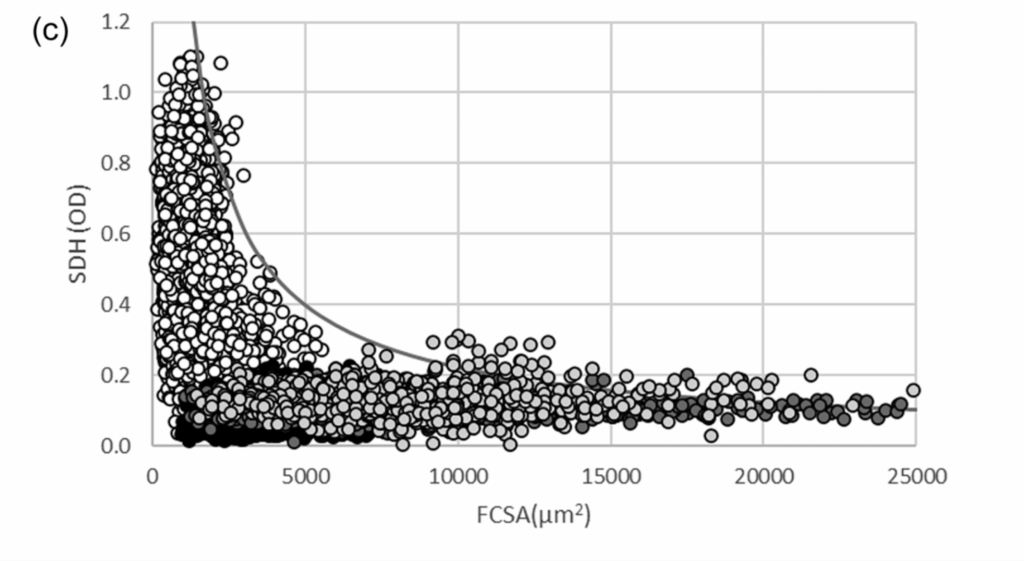
The results were remarkably consistent: a curvilinear, universal upper constraint ties together muscle fiber size and oxidative capacity. As cross-sectional area increased, oxidative capacity decreased, and vice-versa, following the same curve across species, muscle types, ages, and training levels (see Figure below). Indeed, the relationship held constant even in resistance-trained athletes with muscle fibers almost double the size of normal human fibers, as well as in mice, a species with much smaller muscle fiber diameters than humans. In other words, the investigators identified a measurable, highly consistent ceiling that limits large fibers from being maximally aerobically efficient and aerobically efficient fibers from becoming too large.
Implications for training goals
At first, these data might seem discouraging for those hoping to build both strength and aerobic capacity. Yet although Degens et al.’s results may validate certain geometric restrictions on individual muscle fibers, they do not imply that you must sacrifice gains in one endpoint to improve in the other.
First, we must bear in mind that this paper identified a ceiling effect, but most people are nowhere near the ceiling. If you are an elite athlete trying to win the Tour de France or break a powerlifting world record, you may have to give some consideration to the tradeoff between fiber size and aerobic capacity. But for the rest of us, we have plenty of room to add endurance capacity and increase muscle fiber size at the same time. Indeed, we can even see evidence of this in the study results—the bulk of the distribution of datapoints from recreationally active adults falls well below the curve in the Figure above, indicating that they were still operating below the ceiling at which tradeoffs might occur.
It is also important to note that this dynamic applies to individual muscle fibers. Entire muscles will be composed of a variety of diverse types of muscles, and your body will adapt to training with the creation of an appropriate mix of muscle fiber types. Thus, on the level of the whole muscle, you can grow in strength while retaining high aerobic capacity, even if a tradeoff exists at the level of any specific muscle fiber.
The bottom line
A consistent, measurable ceiling limits the size and concurrent oxidative capacity of individual muscle fibers, and for elite athletes, this ceiling may indeed have important implications for training decisions. For instance, it might mean that an Olympic marathon runner may not be simultaneously competitive as a professional bodybuilder and vice versa.
But for the rest of us, we can have our cake and eat it, too. Below the elite end of the spectrum, we can safely assume that our muscle fibers have plenty of room for improving in both size and oxidative capacity. We can continue to engage in a mix of endurance training and resistance training without having to choose between these two modalities—both of which are vital for long-term health and physical function.
For a list of all previous weekly emails, click here.
References
- Degens H, Messa GAM, Tallis J, et al. Diffusion and physical constraints limit oxidative capacity, capillary supply and size of muscle fibres in mice and humans. Exp Physiol. 2025;(EP092750). doi:10.1113/EP092750
- Degens H, Hendrickse P. Unlimited adaptations of muscle fibres to exercise; are you kidding me? Exp Physiol. Published online July 5, 2025. doi:10.1113/EP092983