

If you’ve spent any time with my content, you know I think most people would benefit from eating much more protein than the recommended dietary allowance (RDA) suggests—roughly 1.6 to 2.2 grams per kilogram of body weight per day. A big part of my view on protein requirements is simple: the downsides of eating too little protein are well established, while any potential downsides of eating too much protein are not well supported.
Where I get the most pushback to my usual pro-protein stance is in the case of chronic kidney disease (CKD), where protein restriction has generally been standard advice for decades, especially in advanced disease. To be fair, the physiology behind the recommendation—which I will explain in a moment—makes sense.
But does this historical advice still hold up in practice today?
Indeed, a plausible mechanism is not the same thing as proof that a recommendation improves outcomes—and protein restriction is, at its core, a legacy recommendation. It took hold before the current era of kidney-protective drugs, when there was little else to offer a patient whose kidney function was slipping. That history matters, because today we have medications that slow kidney decline far more reliably than anything available when most of the protein-restriction trials were run. So the real question is not whether protein restriction makes biological sense; it is whether it still earns its place now that we can treat the same physiology pharmacologically. And here the burden of proof has shifted: anyone who continues to recommend routine protein restriction should be able to show that it adds meaningful benefit on top of contemporary therapy—not merely that the mechanism is plausible.
How protein restriction became standard practice
At the most basic level, the kidneys are filters. (Figure 1 will be helpful for understanding the kidney anatomy we are about to walk through.) Each kidney contains about a million working units called nephrons, and each nephron begins with a glomerulus—a tiny bundle of blood vessels that acts like a microscopic sieve. Water and small dissolved substances pass through; larger components, like blood cells and most proteins, stay in the bloodstream.
Filtration depends not only on the filter itself, but also on the pressure pushing fluid across it. When the body breaks down protein, it produces nitrogen-rich waste—chiefly urea—that the kidneys must clear. They respond by filtering more blood, in part by widening the afferent arteriole, the small vessel that carries blood into each filter. This increases blood flow and pressure within the glomerulus, a process known as hyperfiltration. Normally the kidney holds this in check through a built-in brake called tubuloglomerular feedback: a sensor just past each filter reads the amount of sodium in the fluid the filter has produced, and when plenty of sodium flows by, it keeps the afferent arteriole narrowed and pressure in check. Processing a large protein load makes the kidney reabsorb more sodium upstream, before the fluid reaches that sensor—so less arrives, the sensor reads it as “filtering too little,” and the brake releases, letting filtration rise. Put simply, the kidney temporarily raises its filtration rate to match the protein load.
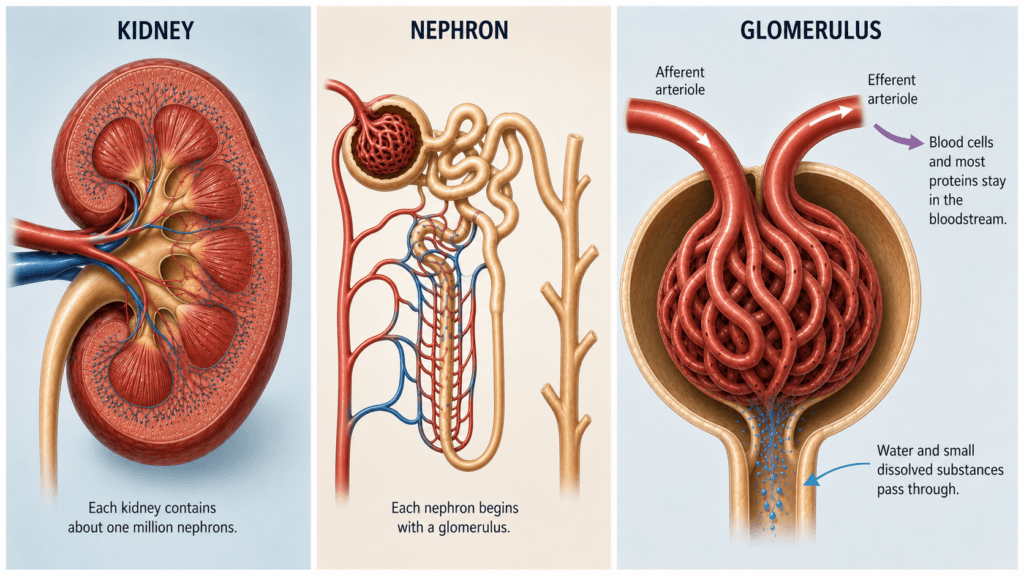
This response is built in for a reason. The kidneys do not normally operate at full capacity; they maintain a degree of filtering reserve that can be recruited when demand rises. For our ancestors, protein intake may often have come in intermittent bursts—a successful hunt followed by leaner stretches—so the ability to increase filtration after a large protein load and then return toward baseline would have been useful.
In healthy kidneys, this increase in filtration appears to be a normal physiological adaptation, and there is no clear evidence that eating high-protein meals routinely damages otherwise healthy kidneys. The concern is different in CKD. When some nephrons have already been damaged or lost, the remaining filters must take on more of the workload and may already be operating under higher pressure. In that setting, an additional rise in intraglomerular pressure could contribute to further damage over time and accelerate the decline in glomerular filtration rate, or GFR. Lower GFR generally reflects more advanced CKD.
So goes the logic behind protein restriction: if dietary protein increases filtration pressure, then eating less protein might reduce stress on the surviving nephrons and slow further decline. That idea eventually made its way into guidelines,1,2 which often recommended protein intakes around 0.6 to 0.8 g/kg/day for patients with stage 3 to 5 CKD—a range that spans from moderate loss of kidney function to kidney failure or near-kidney failure. In more advanced disease, some recommendations went further, using very-low-protein diets of about 0.3 to 0.4 g/kg/day, usually with amino acid or keto acid supplements to make that level of restriction nutritionally feasible.
(Of note, not all guidelines land on such aggressive protein restriction. The 2024 Kidney Disease: Improving Global Outcomes guideline, or KDIGO, is less restrictive. It suggests maintaining protein intake around 0.8 g/kg/day for adults with CKD stages 3 to 5, while avoiding high protein intake above 1.3 g/kg/day in patients at risk of progression.3)
Logically, the premise behind the recommendation makes sense. However, the clinical evidence ultimately supports a much narrower use case than the physiology—and the guidelines—might suggest.
Our research team spends hundreds of hours each month vetting studies and distilling dense literature to deliver evidence-informed insights on health and longevity. If you find value in our work, consider becoming a premium member and supporting our mission.












A look at the evidence
The clearest way to see that is to look at the best available synthesis of the trial data: a 2020 Cochrane review of 17 randomized studies.4 In non-diabetic patients with stage 4 to 5 CKD, very-low-protein diets—0.3 to 0.4 g/kg/day—reduced progression to end-stage kidney disease, compared to low (0.5 to 0.6 g/kg/day) or normal (0.8 g/kg/day and above) protein intake. By contrast, more moderate restriction—0.5 to 0.6 g/kg/day—showed no clear benefit in earlier-stage disease. In other words, the signal of benefit was largely confined to patients with the most advanced CKD receiving the most aggressive protein restriction.
The largest and most influential protein-restriction trial, the Modification of Diet in Renal Disease (MDRD) study, largely failed to confirm the theory.5 It enrolled 840 patients across two separate comparisons, and in each one the more restrictive diet failed to clearly outperform the less restrictive one. Among patients with moderate (roughly stage 3) CKD, a low-protein diet of about 0.6 g/kg/day did not slow the loss of kidney function significantly more than a usual-protein diet of about 1.3 g/kg/day. And among patients with more advanced (roughly stage 4) CKD, restricting further still—a very-low-protein diet of about 0.3 g/kg/day plus supplements—did not clearly outperform that same 0.6 g/kg/day diet. In short, eating less protein wasn’t shown to help.
More concerningly, in long-term observational follow-up, patients originally assigned to the very-low-protein arm had a higher risk of death: 38.9% versus 23% (median time to death of 10.6 years), with a hazard ratio (HR) of 1.92.6 Of course, that does not prove the diet caused the excess deaths; the finding came years after the intervention ended, and other differences between groups could have contributed. But it does make severe protein restriction harder to treat as benign. And it points to a cost that is easy to overlook. The CKD population skews older, and older adults are precisely the group in whom too little protein hastens the loss of muscle mass and strength. Restricting protein in a patient already drifting toward sarcopenia, frailty, and malnutrition is not a neutral act: it trades an uncertain, unproven slowing of kidney decline for a real and well-documented risk of functional decline.
This is the other side of the pro-protein case I opened with: the harm from eating too little protein is not hypothetical. I won’t relitigate the whole argument here—the downsides of underconsumption are well established, while the supposed dangers of higher intake have never held up to scrutiny. In fact, the updated federal dietary guidelines now recommend 1.2 to 1.6 grams per kilogram per day—well above the decades-old RDA of 0.8.7 But if you want the full treatment, I’d point you to our AMA on building and maintaining muscle mass (recently re-released for free), my conversations with Rhonda Patrick and David Allison, and our response to the articles questioning higher-protein diets. The upshot is that protein restriction actively works against preserving strength, mobility, and independence as people age. That is a steep price to pay for a benefit this uncertain.
Taken together, the evidence points to a narrower conclusion than the traditional advice often implies. The strongest case is for supplemented very-low-protein diets in carefully selected patients with advanced CKD, particularly those approaching dialysis—an approach some nephrologists still endorse. That is very different from a broad recommendation that most people with CKD should restrict protein below usual intake.
And even that narrower case has an important limitation: most of these trials were conducted before the newest era of kidney-protective therapy. So while the older data can tell us something about what protein restriction may do in advanced CKD, they do not fully answer the question facing clinicians and patients today: how much does it add when patients are already receiving contemporary CKD care?
The pharmacological landscape of CKD treatment
The landscape of CKD care has changed substantially since many of the low-protein diet trials were conducted. Today, several classes of kidney-protective drugs are either standard of care or increasingly central to treatment: angiotensin-converting enzyme inhibitors and angiotensin receptor blockers, or ACE inhibitors and ARBs; sodium-glucose cotransporter-2 inhibitors, or SGLT2 inhibitors; finerenone, a nonsteroidal mineralocorticoid receptor antagonist; and, in selected patients, glucagon-like peptide-1 receptor agonists, or GLP-1 receptor agonists.
ACE inhibitors and ARBs
ACE inhibitors and ARBs were the first major shift. These drugs became standard in proteinuric CKD—CKD in which abnormal amounts of protein leak into the urine—in the late 1990s. Mechanistically, they lower pressure inside the glomerulus by dilating the efferent arteriole (the vessel that carries blood away from the glomerulus). That reduces proteinuria, or protein leakage into the urine, and slows CKD progression. In randomized trials,8 ACE inhibitors and ARBs reduced the risk of kidney failure by about one-third compared with placebo—and they did so across a broad range of CKD patients, not just the advanced cases where protein restriction showed its only clear signal.
That raises an important question: if ACE inhibitors and ARBs already accomplish much of what protein restriction was meant to do, does adding protein restriction provide additional benefit?
There is one small trial that tested a version of this question.9 Hansen et al. randomized 82 patients with type 1 diabetic nephropathy, most of whom were taking an ACE inhibitor, to either a low-protein diet of 0.6 g/kg/day or a usual-protein diet of about 1.0 g/kg/day. The problem is that the two groups never actually ate that differently: the low-protein group reached only 0.89 g/kg/day rather than the assigned 0.6, while the usual-protein group averaged 1.0—a gap of barely 0.1 g/kg/day. Given how little the diets separated, it’s not surprising that the rate of GFR decline was nearly identical: 3.8 mL/min/year in the low-protein group versus 3.9 in the usual-protein group. The low-protein group did record fewer cases of kidney failure or death, but with such a small study and so little real difference in protein intake, that finding is hard to attribute to the diet with any confidence. More than anything, it shows how rarely this question has been put to a real test.
SGLT2 inhibitors
SGLT2 inhibitors changed the field even more, and they act directly on the tubuloglomerular feedback loop described above. SGLT2 inhibitors—such as empagliflozin, dapagliflozin, and canagliflozin—push the system in the opposite direction: by blocking the reabsorption of glucose and sodium early in the nephron, they let more sodium reach the sensor, so the kidney narrows the afferent arteriole and lowers pressure inside the filter. Put simply, a high-protein meal releases the brake on filtration; an SGLT2 inhibitor helps put it back on.
Of note, this also explains what can otherwise look like a concerning feature of these drugs. When patients first start an SGLT2 inhibitor, GFR often falls modestly. In most cases, that initial dip reflects a reduction in pressure inside the glomerulus rather than kidney injury. After that early adjustment, kidney function tends to decline more slowly than it would without treatment.
Because the two drug classes act on opposite sides of the filter—ACE inhibitors and ARBs on the efferent arteriole, SGLT2 inhibitors on the afferent—their effects are complementary, which is why they are now commonly used together. Large randomized trials of canagliflozin, dapagliflozin, and empagliflozin found substantial reductions in kidney disease progression, with benefits extending beyond patients with diabetes and into fairly advanced CKD.10–12
That makes the question around protein restriction more pointed. A low-protein diet and an SGLT2 inhibitor both aim, at least in part, to reduce pressure inside the glomerulus. If the drug already restores the feedback signal that a protein load disrupts, how much additional benefit is left for the diet to provide? Protein restriction may still add something, but this specific question has never been formally tested in a large randomized trial.
Finerenone and GLP-1 receptor agonists
Finerenone13 and GLP-1 receptor agonists14 also appear to protect the kidneys in patients with diabetes, though through different mechanisms than protein restriction. Finerenone seems to work largely through anti-inflammatory and anti-fibrotic pathways, while GLP-1 receptor agonists improve glycemic control, body weight, and broader cardiometabolic risk. In theory, this means these drugs and diet could be complementary. But again, that has not been formally tested in a large trial of low-protein diet layered on top of modern CKD therapy.
The landscape today
All of this changes the question around protein restriction. In older trials, many patients were untreated or were receiving, at most, an ACE-inhibitor or ARB. Today, patients may be treated with ACE inhibitors or ARBs, SGLT2 inhibitors, finerenone, GLP-1 receptor agonists, better blood pressure control, and better metabolic management. When several effective therapies are layered together, the absolute rate of kidney decline may already be lower than it was in historical cohorts. So how much incremental benefit can a low-protein diet still provide?
In truth, we do not really know. To date, no large randomized trial has tested the additive value of a low-protein diet on top of optimized current CKD pharmacotherapy. But I am skeptical that routine protein restriction would add meaningful benefit for most patients already receiving today’s therapy, especially when the strongest diet signal appears limited to patients with advanced CKD using the most aggressive form of protein restriction.
That skepticism is strongest for ACE inhibitors, ARBs, and SGLT2 inhibitors, because these drugs seem to target much of the same physiology that protein restriction was meant to address: excess pressure inside the glomerulus, hyperfiltration, and workload on the remaining nephrons. If those pathways are already being treated pharmacologically, the incremental benefit of broad protein restriction may be small.
One more point: diet can still matter in CKD, but that does not mean blanket protein restriction is the answer. Food choices can affect several problems that come with reduced kidney function—too much phosphorus in the blood, too much acid buildup, and symptoms that come from the kidneys struggling to clear protein-related waste. But these problems have more targeted solutions. Phosphorus, for example, can often be managed by limiting processed foods with phosphorus additives, choosing protein sources with less absorbable phosphorus, and, when needed, using phosphate binders, which bind dietary phosphate in the GI tract so that it cannot be absorbed and is excreted in the stool. Acid buildup can be treated with bicarbonate. And protein-related waste becomes more of a symptom-management issue late in the disease course. In other words, many of the specific problems that push toward protein restriction have more targeted treatments. Using those tools may help avoid the tradeoff that comes with eating too little protein.
The bottom line
The strongest case for restriction has always been in advanced CKD, where fewer functioning nephrons remain and reducing kidney workload seems most likely to matter. But that is also where available pharmacotherapy changes the logic most. ACE inhibitors, ARBs, and SGLT2 inhibitors already target much of the same physiology protein restriction was meant to address.
So my view is this: no randomized trial has ever shown that protein restriction adds meaningful benefit on top of contemporary CKD therapy. Until one does, the incremental value of restricting protein below normal intake is, at best, uncertain—even in advanced CKD, where the rationale was always strongest. Set against a real and well-documented nutritional downside, routine protein restriction, and especially aggressive restriction, looks far less compelling than some current guidelines imply. Until that evidence exists, routine protein restriction should no longer be viewed as the default standard of care, but rather as an intervention that still needs to justify its place alongside contemporary CKD therapy.
For a list of all previous weekly emails, click here.
References
1. Ikizler TA, Burrowes JD, Byham-Gray LD, et al. KDOQI Clinical Practice Guideline for nutrition in CKD: 2020 update. Am J Kidney Dis. 2020;76(3 Suppl 1):S1-S107. doi:10.1053/j.ajkd.2020.05.006
2. Bawazir A, Topf JM, Hiremath S. Protein restriction in CKD: an outdated strategy in the modern era. J Bras Nefrol. 2025;47(1):e2024PO03. doi:10.1590/2175-8239-JBN-2024-PO03en
3. Kidney Disease: Improving Global Outcomes (KDIGO) CKD Work Group. KDIGO 2024 clinical practice guideline for the evaluation and management of chronic kidney disease. Kidney Int. 2024;105(4S):S117-S314. doi:10.1016/j.kint.2023.10.018
4. Hahn D, Hodson EM, Fouque D. Low protein diets for non-diabetic adults with chronic kidney disease. Cochrane Database Syst Rev. 2020;10(11):CD001892. doi:10.1002/14651858.CD001892.pub5
5. Klahr S, Levey AS, Beck GJ, et al. The effects of dietary protein restriction and blood-pressure control on the progression of chronic renal disease. Modification of Diet in Renal Disease Study Group. N Engl J Med. 1994;330(13):877-884. doi:10.1056/NEJM199403313301301
6. Menon V, Kopple JD, Wang X, et al. Effect of a very low-protein diet on outcomes: long-term follow-up of the Modification of Diet in Renal Disease (MDRD) Study. Am J Kidney Dis. 2009;53(2):208-217. doi:10.1053/j.ajkd.2008.08.009
7. Kennedy RF Jr, Rollins BL. Dietary Guidelines for Americans, 2025–2030. U.S. Department of Health and Human Services; 2025. https://cdn.realfood.gov/DGA.pdf
8. Xie X, Liu Y, Perkovic V, et al. Renin-angiotensin system inhibitors and kidney and cardiovascular outcomes in patients with CKD: A Bayesian network meta-analysis of randomized clinical trials. Am J Kidney Dis. 2016;67(5):728-741. doi:10.1053/j.ajkd.2015.10.011
9. Hansen HP, Tauber-Lassen E, Jensen BR, Parving HH. Effect of dietary protein restriction on prognosis in patients with diabetic nephropathy. Kidney Int. 2002;62(1):220-228. doi:10.1046/j.1523-1755.2002.00421.x
10. Perkovic V, Jardine MJ, Neal B, et al. Canagliflozin and renal outcomes in type 2 diabetes and nephropathy. N Engl J Med. 2019;380(24):2295-2306. doi:10.1056/NEJMoa1811744
11. Heerspink HJL, Stefánsson BV, Correa-Rotter R, et al. Dapagliflozin in patients with chronic kidney disease. N Engl J Med. 2020;383(15):1436-1446. doi:10.1056/NEJMoa2024816
12. The EMPA-KIDNEY Collaborative Group, Herrington WG, Staplin N, et al. Empagliflozin in patients with chronic kidney disease. N Engl J Med. 2023;388(2):117-127. doi:10.1056/NEJMoa2204233
13. Bakris GL, Agarwal R, Anker SD, et al. Effect of finerenone on chronic kidney disease outcomes in type 2 diabetes. N Engl J Med. 2020;383(23):2219-2229. doi:10.1056/NEJMoa2025845
14. Perkovic V, Tuttle KR, Rossing P, et al. Effects of semaglutide on chronic kidney disease in patients with type 2 diabetes. N Engl J Med. 2024;391(2):109-121. doi:10.1056/NEJMoa2403347


