
Alzheimer’s disease progressively and irreversibly impairs memory and thinking, eventually compromising the ability to function independently. As we discussed in a recent premium article, much of the excitement around Alzheimer’s today centers on prevention and therapies designed to slow the disease itself. But millions of people already live with Alzheimer’s, and for them, a treatment does not necessarily have to alter the course of the disease to be useful. In fact, for decades, the mainstay of Alzheimer’s treatment has been drugs that work in exactly this way: improving some of the symptoms of Alzheimer’s without necessarily changing the underlying disease progression.
Because these drugs do not alter the underlying disease process, their value depends largely on what their symptomatic benefits actually amount to. How much cognitive function can they actually preserve? And what might that difference mean for a patient?
Making more of what remains
Today, discussions about the biology of Alzheimer’s disease tend to revolve around the amyloid hypothesis, the idea that the accumulation of a protein called amyloid-beta in the brain helps drive the disease process. Earlier work, however, focused on the cholinergic hypothesis—built on the observation that the disease was associated with a substantial loss of neurons that communicate through acetylcholine. As these neurons degenerate and die, acetylcholine signaling declines, and this loss of signaling was proposed to contribute, at least partially, to the cognitive deficits of Alzheimer’s disease.
While those neurons that are lost cannot simply be brought back, perhaps it is possible to get more out of the ones that remain. Cholinesterase inhibitors were developed with this idea in mind—blocking the activity of cholinesterase, the enzyme that breaks down acetylcholine. With its breakdown slowed, any acetylcholine released by neurons can stick around longer and continue signaling between neighboring cells—potentially making up for some of the degenerated cholinergic neurons, thereby improving cognitive function.
Given these drugs have been a mainstay of Alzheimer’s treatment for decades, you may have already deduced two things: first, that the cholinergic hypothesis is at least partially correct; and second, that the drugs designed around it—the cholinesterase inhibitors donepezil, galantamine, and rivastigmine—work in the clinic.
And yes, these drugs do “work.” At least in the sense that patients taking them perform better on measures of cognitive function than those taking placebo. That is consistent with the idea that loss of cholinergic signaling contributes to the cognitive symptoms of Alzheimer’s. But the cholinergic hypothesis is not the whole story: those neurons are still being lost as part of the underlying disease process, whether driven by amyloid or other pathology.
So, these drugs can improve the signaling that remains, but they cannot reverse that cell loss. And if they are addressing only one part of the problem, there may be a limit to how much improvement they can provide.
Our research team spends hundreds of hours each month vetting studies and distilling dense literature to deliver evidence-informed insights on health and longevity. If you find value in our work, consider becoming a premium member and supporting our mission.














How much more?
Across numerous randomized clinical trials, the three cholinesterase inhibitors still in use today all produced similar improvements to one another when compared with placebo. In these trials, patients underwent cognitive assessments through numerous tests, but for simplicity, we’ll focus on the Alzheimer’s Disease Assessment Scale–Cognitive Subscale, or ADAS-Cog. This test asks patients to perform a series of tasks that probe memory, language, and other aspects of cognition—for example, recalling a list of words, naming common objects, following commands, and identifying the date and where they are.
In a Cochrane review that pooled five trials and more than 1,100 patients, those taking donepezil scored an average of 2.67 points better than those taking placebo after about six months.1 Similarly, rivastigmine was associated with a 1.79-point advantage,2 while the most recent Cochrane review of galantamine found a 2.86-point difference.3 As a whole, this class of drug consistently gives about a 2- to 3-point advantage over placebo on the ADAS-Cog after six months of treatment.
However, there are a few caveats to consider with this 2- to 3-point difference.
First is what the scale of the change actually means. The standard ADAS-Cog is scored from 0 to 70, with higher scores indicating greater cognitive impairment. A cognitively normal older adult might score around 5, while someone with mild-to-moderate Alzheimer’s disease will often score in the 20s–30s.4
And what does a 2- to 3-point difference actually look like? There is no single answer, because the ADAS-Cog combines performance across several different tasks—points could all be concentrated in one cognitive faculty for one patient, while being distributed across multiple domains for another.
But to give a sense of scale, a one-point difference on the word-recall portion corresponds roughly to remembering one additional word from a 10-word list on each attempt, while a one-point difference in orientation might mean correctly identifying one additional detail, such as the date, day of the week, or location. A few points spread across the test could therefore reflect several small differences in memory, language, and orientation—it may not be one large, obvious change in day-to-day cognition.
Estimates of the minimum clinically important difference on the ADAS-Cog vary, but in mild Alzheimer’s disease they generally fall around 3 to 4 points.5,6 Although these thresholds are imperfect for interpreting differences between treatment groups, they put the roughly 2- to 3-point average effect of cholinesterase inhibitors near the lower end of what might be considered clinically meaningful.
Second, the 2- to 3-point difference does not necessarily mean that patients taking these drugs improve by 2 to 3 points. In fact, much of the advantage of taking these drugs in trials appears to come from the placebo group declining rather than the active group actually improving much (see an example in the figure, below). That doesn’t mean an individual can’t improve, it just means that even if someone doesn’t improve, cholinesterase inhibitors may still be preserving cognitive function that would otherwise have been lost.
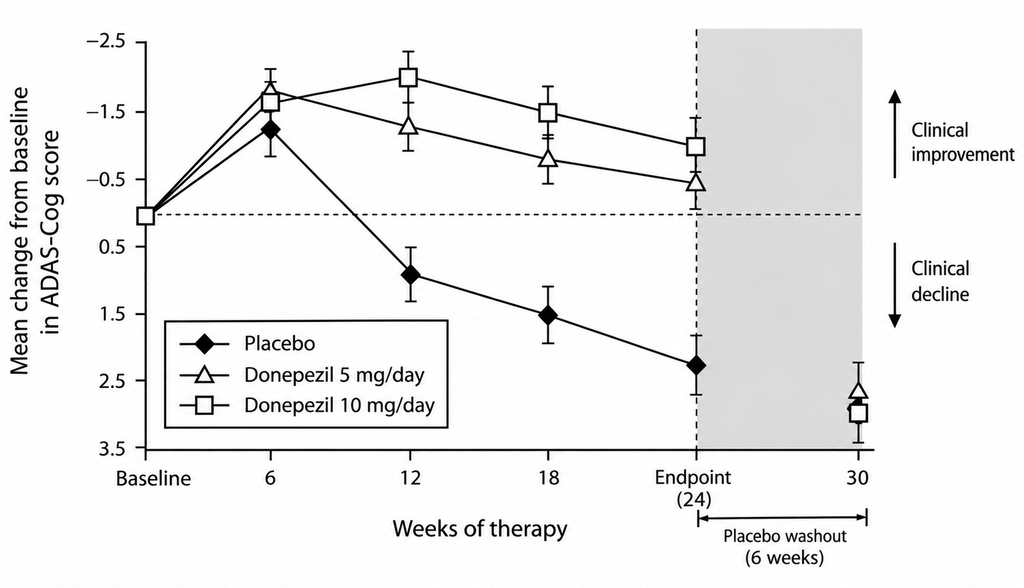
This is because the 2- to 3-point difference is between groups, not an improvement within the same person. Randomization gives us a good estimate of what would have happened on average without treatment. But for any individual patient, we don’t observe what would have happened if they hadn’t taken the drug. Someone taking donepezil may continue to decline and still be benefiting if they would have declined faster without it.
And remember, this treatment really only impacts cognitive symptoms, without slowing disease progression—remove the drug, and the measurable advantage over placebo disappears. For example, in one trial of donepezil, patients who had previously received donepezil were indistinguishable on the ADAS-Cog from those who had received placebo after a six-week washout period (shown in the figure above at week 30).7
The trade-offs
Given the modest and temporary nature of this benefit, the next question is what treatment asks of the patient in return—and, for most patients, the answer is relatively little. In pooled donepezil trials, for example, 11% of patients discontinued treatment because of an adverse event, compared with 7% receiving placebo—higher, yes, but not overwhelmingly concerning.8
Adverse reactions are often an issue of tolerability rather than toxicity with these drugs. Acetylcholine is an important signalling molecule throughout the body, and neither acetylcholine nor these inhibitors act specifically within the brain. The issues with tolerability are explained by the same mechanism that gives cholinesterase inhibitors their benefit: acetylcholine signals are a normal part of the gastrointestinal system, and many common side effects (nausea, diarrhea, vomiting, and loss of appetite) arise in the GI tract.
Newer approaches have also attempted to preserve the benefits of cholinesterase inhibition while reducing some of its side effects. Benzgalantamine, approved in 2024 for mild-to-moderate Alzheimer’s dementia, is one example. It is a prodrug that remains inactive until after absorption into the bloodstream, where it is then converted to galantamine. The formulation is designed to reduce gastrointestinal exposure and potentially improve tolerability, though whether it meaningfully reduces GI side effects relative to existing cholinesterase inhibitors has not yet been established in randomized comparative trials.9
For many patients, then, the adverse effects are manageable, though tolerability varies among drugs and patients. The more important question may be whether that remains true as the disease progresses. Loss of appetite or weight, for example, may become a problem independent of the drug, making even mild nausea or diarrhea less acceptable. And as memory and independence decline, the practical burden of taking a medication can also become more consequential—especially if a patient begins forgetting doses, taking them more than once, or otherwise cannot manage the regimen safely without help.
This makes the decision to continue treatment an ongoing conversation between the patient, their caretakers, and the prescribing clinician. Cholinesterase inhibitors offer a modest symptomatic benefit, but they also generally come with relatively little risk or burden. As long as a patient is tolerating the drug and taking it safely, there may be little reason to give up even a small amount of preserved cognitive function. Stopping may make more sense when the side effects or practical burden of treatment become substantial enough to outweigh that benefit. Until then, a modest benefit may still be worth preserving when there is relatively little downside to doing so.
The bottom line
Much of the progress in Alzheimer’s research is now aimed at preventing disease, slowing its progression, and eventually repairing some of the damage it causes. Those are the results that could fundamentally change what an Alzheimer’s diagnosis means. Cholinesterase inhibitors can be effective, but they do something much smaller: they treat the symptoms of the disease, modestly improving or maintaining cognitive function without altering the underlying neurodegeneration.
That is not the ultimate goal of Alzheimer’s treatment or research—these drugs do not stop or reverse disease—but they are, as it stands, the treatments that are actually widely available. For someone living with Alzheimer’s now, remembering a little more, remaining better oriented, or retaining an ability that otherwise might have been lost is not nothing. Until we can change the disease itself, there is value in preserving what we can—and cholinesterase inhibitors are the clear starting point worth considering when navigating this difficult diagnosis.
For a list of all previous weekly emails, click here.
References
1. Birks JS, Harvey RJ. Donepezil for dementia due to Alzheimer’s disease. Cochrane Database Syst Rev. 2018;6(6):CD001190.
2. Birks JS, Grimley Evans J. Rivastigmine for Alzheimer’s disease. Cochrane Database Syst Rev. 2015;(4):CD001191.
3. Lim AWY, Schneider L, Loy C. Galantamine for dementia due to Alzheimer’s disease and mild cognitive impairment. Cochrane Database Syst Rev. 2024;11(11):CD001747.
4. Zec RF, Landreth ES, Vicari SK, et al. Alzheimer disease assessment scale: useful for both early detection and staging of dementia of the Alzheimer type. Alzheimer Dis Assoc Disord. 1992;6(2):89-102.
5. Schrag A, Schott JM, Alzheimer’s Disease Neuroimaging Initiative. What is the clinically relevant change on the ADAS-Cog? J Neurol Neurosurg Psychiatry. 2012;83(2):171-173.
6. Watt JA, Veroniki AA, Tricco AC, Straus SE. Using a distribution-based approach and systematic review methods to derive minimum clinically important differences. BMC Med Res Methodol. 2021;21(1):41.
7. Rogers SL, Farlow MR, Doody RS, Mohs R, Friedhoff LT. A 24-week, double-blind, placebo-controlled trial of donepezil in patients with Alzheimer’s disease. Donepezil Study Group. Neurology. 1998;50(1):136-145.
8. Pratt RD, Perdomo CA, Surick IW, Ieni JR. Donepezil: Tolerability and safety in Alzheimer’s disease. Int J Clin Pract. 2002;56(9):710-717.
9. Alpha Cognition Inc. Building new Transformative Treatments for Alzheimer’s and ALS. Accessed September 17, 2026. https://www.alphacognition.com/investors/news/alpha-cognition-reports-positive-top-line-results-from-beacon-real-world-study-of-zunveyl-in-alzheimers-disease