In this “Ask Me Anything” (AMA) episode, Peter takes a deep dive into thyroid health and explains why diagnosing and managing thyroid dysfunction is unusually complex. He begins with the basic biology of the thyroid gland and three commonly measured hormones—free T4, free T3, and TSH. He explains how T4 is converted to the active hormone T3 and the important functions T3 performs throughout the body. He also explains what reverse T3 is and when it may be useful to measure it. Peter then breaks down thyroid blood tests and their limitations and provides a practical framework for evaluating suspected thyroid dysfunction. He explains why symptoms alone are insufficient for diagnosis and reviews the criteria for diagnosing hypothyroidism, along with conditions that can mimic it. He also explores how hypothyroidism can be both underdiagnosed and overtreated and how to navigate subclinical hypothyroidism. Peter discusses treatment with T4 and T3, including why some patients continue to experience symptoms despite standard T4 replacement. He also explains how thyroid medications should be taken to optimize absorption. Additional topics include Hashimoto’s disease, thyroid considerations during pregnancy, hyperthyroidism, the risks of excess iodine, and supplements marketed to support thyroid function. Finally, Peter offers guidance for patients who continue to feel unwell despite apparently normal thyroid tests.
If you’re not a subscriber and listening on a podcast player, you’ll only be able to hear a preview of the AMA. If you’re a subscriber, you can now listen to this full episode on your private RSS feed or on our website at the AMA #89 show notes page. If you are not a subscriber, you can learn more about the subscriber benefits here.

Would you like access to this entire podcast episode, its extensive show notes, and more premium content?
We discuss:
Timestamps: There are two sets of timestamps associated with the topic list below. The first is audio (A), and the second is video (V). If you are listening to this podcast with the audio player on this page or in your favorite podcast player, please refer to the audio timestamps. If you are watching the video version on this page or YouTube, please refer to the video timestamps.
- Why thyroid management is unusually complex and what the thyroid does [A: 2:00, V: 0:11];
- Why symptoms are insufficient for diagnosis and the risks of underdiagnosis and overtreatment [A: 9:00, V: 7:45];
- Regulation of the thyroid axis and conversion of T4 to T3 [A: 13:30, V: 12:30];
- Reverse T3 and the metabolic effects of T3 [A: 20:00, V: 19:20];
- Thyroid blood tests, assay limitations, and who should be tested [A: 22:45, V: 22:21];
- Causes and mimics of hypothyroidism and the criteria for diagnosis [A: 29:00, V: 29:15];
- Navigating subclinical hypothyroidism [A: 34:30, V: 35:03];
- Treating hypothyroidism with T4 and T3 [A: 37:00, V: 38:00];
- Hashimoto’s disease, pregnancy, and associated autoimmune risks [A: 42:45, V: 44:11];
- Proper timing and administration of thyroid medication [A: 43:45, V: 45:12];
- Causes, symptoms, diagnosis, and treatment of hyperthyroidism [A: 45:15, V: 46:53];
- Iodine excess, the risks of thyroid-support supplements, and evidence for dietary interventions [A: 53:45, V: 56:17];
- A practical framework for evaluating and treating patients who suspect thyroid dysfunction [A: 59:30, V: 1:02:14]; and
- More.
Show Notes
Why thyroid management is unusually complex and what the thyroid does [A: 2:00, V: 0:11];
Explain why this is such a complex, complicated topic
- One reason is that the regulation of thyroid hormones is quite complicated
“It’s a hormone system for which the Goldilocks principle applies. Too much is a problem and too little is a problem.”‒ Peter Attia
- Conversely, if you think about testosterone (male androgens) that’s not the case
- There’s really no naturally occurring scenario where you have too much of it
- Even when people are having testosterone replaced, if you give them too much, they generally just feel better
- 1 – It’s actually a more asymmetric problem, but the thyroid is particularly nuanced
- 2 – There’s a feedback system in the brain that works a lot like other hormones we know about, including testosterone
- 3 – A second thing that then makes this really complicated is that you have an inactive hormone 3 that is the thing that’s actually getting secreted by the thyroid gland
- That gets converted to an active hormone locally
- Additionally, there are different ways that it gets converted, so there are different enzymes that convert it
- We’re going to talk about all of these things
- 4 – How you interpret the lab test is a little bit problematic
- In comparison, when you are looking at something like estrogen, progesterone, or testosterone: you can very accurately measure those hormones
- Provided you’re using the right assay, like an LC-MS test
- As we’ll discuss in the thyroid, that’s not always the case
- 5 – Another thing that makes this complicated is the importance of how symptoms fit into the diagnosis
- That should be part and parcel with every endocrine diagnosis
- It’s just that the symptoms of low estrogen and progesterone and testosterone are much more apparent and have fewer overlaps with other potential diagnoses than we see with thyroid
When you take all of these things together, managing the thyroid hormone is sort of a ripe environment for ideologic battles and pseudoscience and sort of a little bit of chicanery when it comes to sometimes practitioners doing more harm than good when they’re trying to treat patients
Explain what the thyroid is and what it does
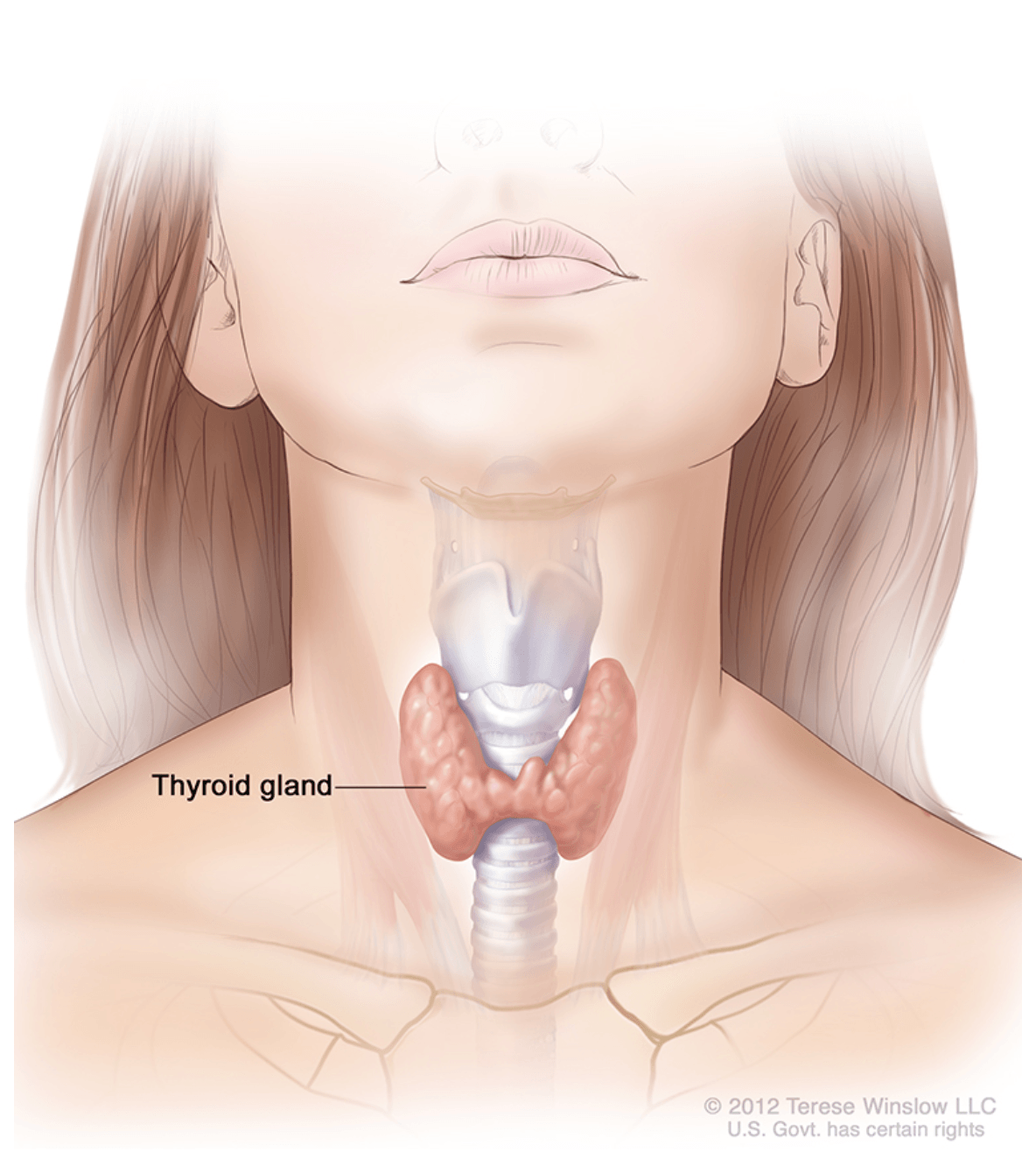
- It’s a small gland with two lobes on either side of your throat, really sitting on top of your voice box
- Just below the Adam’s apple is really where it starts and then it rises to the side and then goes down the other side
- [shown in the figure below]
- It makes a hormone, but primarily the one that it makes is called T4
- It’s called T4 because it has four iodines on it
⇒ The downstream of that effect is that this hormone (T4) regulates the metabolic rate of basically every cell in the body
- Analogy: you can think of the thyroid gland as the gain knob on your body’s metabolic amplifier
T4 is not really deciding what your cells do so much as how loudly they do it
- If you have too little signal and everything is basically going to run cold and slow, your heart rate’s going to drop, your weight’s going to probably creep up, you feel like you’re operating at half capacity, you’re low in energy, etc.
- Conversely, too much of it, and everything goes up
- Again, it’s not a big line between too much and too little,
- Everything’s hot and fast
- Your heart rate goes up
- You might even have unexpected weight loss, anxiety, insomnia, atrial fibrillation, all sorts of things like that
⇒ Prevalence: roughly 5% of adults in the United States have some clinically meaningful thyroid dysfunction—it’s wildly prevalent
- And that means by definition, many people listening to us right now are experiencing that
Peter shares, “It’s one of the more commonly mismanaged conditions I see.”
Why do you think this can be such a contentious topic for doctors and people to understand?
The system is complex, combined with the fact that we don’t have visibility into its moving parts—that creates a bit of a perfect storm
- The thyroid mostly secretes an inactive pro-hormone, T4
- Then there’s a decision about how much of that hormone becomes the active hormone, T3
- But that decision is happening locally, tissue by tissue
- Now, TSH (thyroid-stimulating hormone) is a great marker of whether the gland is being told to work harder
- But it’s a step removed from what’s actually happening inside the liver, the heart, the brain
There’s also a real philosophical split
- There’s a camp of physicians that think hypothyroidism is underdiagnosed, undertreated
- Think of this as: when you’re a hammer, everything is a nail camp
- Any problem that anybody shows up with, if you’re depressed, if you’re having GI issues, if you’re having sleep… whatever the problem is, it’s hypothyroidism
- At the other end of the spectrum, you have a camp of other folks who say this is completely over-diagnosed
- The opposite of: everybody has hypothyroidism school of though
- And basically we’re only going to treat hypothyroidism if it is so overt that a medical school student after one hour of an endocrinology class would be able to make this diagnosis blindfolded
Peter thinks both of these schools are incorrect and that there’s a messy middle ground where the truth probably lies
“The goal of this podcast, of course, is then to walk people through the physiology carefully enough that you can see both the grains of truth on each side of those schools of thought, but perhaps more importantly, what they might be missing and therefore where we can hopefully land on a place to treat people.”‒ Peter Attia
{end of show notes preview}